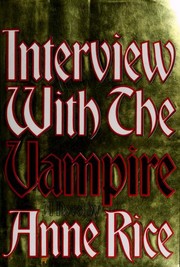
Start with Interview With the Vampire. It is short, it came first, and everything afterwards is a reply to it: Louis gives a tape-recorded confession to a journalist in a San Francisco room, and the next book exists because the vampire he blames for his condition disagreed with it.
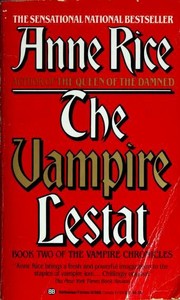
Here is the honest caveat, because a lot of readers hit it. Interview With the Vampire is mannered, static and almost entirely interior, and a fair number of people stall about eighty pages in. If that happens, jump to The Vampire Lestat rather than giving up — it is faster, funnier and far larger in scope, and it is explicitly written as Lestat's rebuttal to the book you just put down. Come back to Louis afterwards. Skipping it permanently costs you the argument the whole series runs on.
The Vampire Chronicles in order
Interview With the Vampire (1976), The Vampire Lestat (1985), The Queen of the Damned (1988), The Tale of the Body Thief (1992), Memnoch the Devil (1995), The Vampire Armand (1998).
The Queen of the Damned is where the mythology arrives — the origin of vampires, the six-thousand-year-old Akasha, and the Talamasca, the order of scholars who quietly watch all of this and who turn out to matter enormously later. Most readers treat these first three as the core and a good number never go further.
The Tale of the Body Thief is the smallest and tightest of the run, a body-swap novel in which Lestat trades his for a mortal one and discovers what he actually gave up. Memnoch the Devil is where the series splits its readership: Lestat is taken on a tour of Heaven and Hell by the Devil, who argues his case at length, and it is either the most ambitious book Rice wrote or the point at which the vampires stopped being the subject. Both readings are defensible.
The Vampire Armand and Pandora are side-histories rather than plot — Armand's Renaissance boyhood and Pandora's Rome. Read them after The Queen of the Damned at the earliest, since both assume you know who Marius is.
Where to stop
Two honest answers. Stop after The Queen of the Damned if you want the trilogy that made her reputation and nothing else. Stop after Memnoch the Devil if you want the full arc of the theological argument the series was building toward, which is genuinely where it lands.
Blood and Gold and Blood Canticle, neither in this path, are the stretch most readers rate weakest. Prince Lestat, The Vampire Chronicles (2014) restarted the series after eleven years away and reads as a deliberate reset, gathering the surviving cast into a single plot; it is better than the books immediately before it and it assumes you have read them.
The Mayfair witches
The Witching Hour, Lasher and Taltos are a separate trilogy about a New Orleans family of witches and the entity attached to them across thirteen generations. The Witching Hour is around a thousand pages and a substantial middle section is a Talamasca dossier — a file of documents, letters and interviews tracing the family line. Readers either find that the best thing she wrote or unbearable, and there is no way to know in advance except to try it.
Where the two series merge, and why it matters
Merrick and Blackwood Farm fold the Mayfair material directly into the Chronicles, and Blood Canticle completes the merge. The practical consequence for reading order is simple: if you intend to read Merrick and Blackwood Farm, read the Mayfair trilogy first, or characters will arrive with histories the book assumes you already have.
The historical novels
Two of the best books in this path have no supernatural content at all. Cry to Heaven (1982) is about castrati singers in eighteenth-century Italy — the surgery, the conservatories, the careers, and what it cost. The Feast of All Saints (1979) is about the gens de couleur libres, the free people of colour of antebellum New Orleans, caught between a society that would not have them and one they refused to join. It is the least read of her novels and a number of readers consider it the best written.
Not in this path, named plainly so the list does not look complete: The Mummy, Servant of the Bones, the Christ the Lord novels, and the Sleeping Beauty trilogy published under the name A.N. Roquelaure, which is explicit erotica and a wholly different register.
More gothic and horror reading sits on the Anne Rice hub.
Follow the full ordered path here: Vampire Chronicles books in order: where to start with Anne Rice.