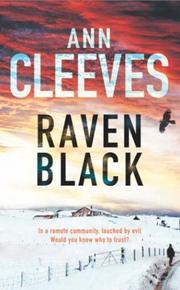
Start with Raven Black. It is the first Shetland novel, it won the Crime Writers' Association Gold Dagger in 2006 after twenty years of Cleeves writing midlist crime nobody was buying, and it is the book where her method arrives fully formed: a closed community, a victim everybody had a reason to dislike, and a detective who solves the case mostly by listening.
The alternative most people are pointed at is The Crow Trap, because Vera Stanhope is the character the television made famous. Come to Vera second. The reason is structural rather than snobbish, and it is explained below.
The five series, sorted out
This is the actual problem with starting Ann Cleeves, so take it first. She has written five separate series with no shared characters.
Shetland follows Jimmy Perez and runs to eight books. Vera Stanhope, a Northumberland detective, runs to ten and counting. Two Rivers follows Matthew Venn in North Devon. Before either of those there was the Inspector Ramsay series, six novels in the 1990s, none of which appear in this path. And before all of it came the Palmer-Jones books, her debut series, about two birdwatchers who investigate murders.
Shetland, and why it must be read in order
Raven Black, White nights, Red bones and Blue Lightning were written as a deliberate quartet, one per season, and were originally intended to be all there was. That matters because Blue Lightning ends with a death that permanently changes the series, and the four books that follow — Dead Water, Thin Air, Cold earth and Wild fire — are written on the far side of it. Reading Shetland out of sequence is the one genuine ordering mistake available in Cleeves, and it is not recoverable.
Wild fire was written as the closing book and reads like one. Eight books, one arc, read them in the order above.
Two notes for anyone arriving from the BBC adaptation. The television series ran well past the novels and invented most of its later cases, so the two are not interchangeable and the screen version will not spoil the books beyond the first few. And the setting is not decoration — the islands' geography, the light, the ferry timetable and the impossibility of anonymity in a place that small are load-bearing in every plot.
Vera Stanhope
Order matters far less here. The books are near-standalone and Vera does not develop across them so much as accumulate.
The Crow Trap is first but is an odd door in: it is long, its structure hands large sections to three other women, and Vera herself does not appear until well into the book. If you came from the ITV series with Brenda Blethyn expecting Vera on page one, start with Telling Tales or Hidden Depths instead and come back to The Crow Trap later. Harbour Street is among the strongest in the run. Silent Voices, The Glass Room, The Moth Catcher, The Seagull, The Darkest Evening and The Rising Tide are not in this list.
Two Rivers
The Long Call opens the Matthew Venn series — North Devon, and a detective who grew up inside a closed evangelical community and was expelled from it. It is the most personal of her setups and the one where the outsider-detective idea is least metaphorical. The Heron's Cry and The Raging Storm follow it and are not in this path.
Palmer-Jones
A bird in the hand (1986) is her first published novel, introducing George and Molly Palmer-Jones, amateur detectives on the competitive birdwatching circuit. It is a period piece now and a much lighter book than anything above. Read it once you already like her, as an origin document rather than an entry point.
More crime reading is collected on the Ann Cleeves hub.
Follow the full ordered path here: Ann Cleeves books in order: where to start with Vera and Shetland.