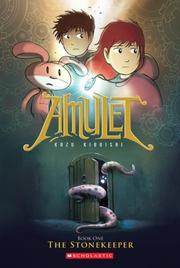
Start with The Stonekeeper. It is Amulet volume one, and there is no alternative entry point — the series is a single continuous story with a single set of protagonists, and volume two begins on the heels of volume one.
The confusion worth clearing up first is the numbering. The spines say Amulet Book One, Book Two and so on, but each volume also has its own title, and libraries and catalogues — including this one — file them under the volume title alone. So The Stonekeeper is book one, and if you are hunting for "Amulet 3" what you actually want is The cloud searchers.
The nine volumes in order
The Stonekeeper (2008), The Stonekeeper's Curse (2009), The cloud searchers (2010), The Last Council (2011), Prince of the Elves (2012), Escape from Lucien (2014), Firelight (2016), Supernova (2018), Waverider (2024).
That is the complete series. Kazu Kibuishi has said the nine-book shape was the plan, and Waverider ends it — which matters, because there was a six-year gap between volume eight and volume nine and a lot of readers gave up assuming it had been abandoned. It has not been. The story finishes.
What the series actually is
Emily and Navin move with their mother into a great-grandfather's derelict house, Emily finds an amulet in the study, and their mother is taken by a creature in the cellar. Rescuing her drops all three into Alledia, a world of walking houses, elf armies and mechanical robots, where Emily turns out to be a Stonekeeper — a wielder of one of a set of amulets that grant enormous power and then attempt to take over the person holding it.
That last part is the engine of the whole series. The amulet talks to Emily, its advice is usually correct, and the cost of listening to it is her gradually ceasing to be herself. Kibuishi keeps that going for nine volumes without resolving it cheaply, and it is the reason the series reads as more than a chase.
The art carries an unusual amount of the storytelling. Kibuishi paints in full colour with a cinematic sense of scale, and the world-building lands in single wide panels rather than in dialogue. Readers who find the text sparse are not wrong; the drawing is doing that work.
For the adult handing these over
The books are published by Scholastic Graphix for roughly the eight-to-twelve shelf, and each volume runs about 200 pages that a confident reader will finish in an hour.
Content, as plain fact rather than warning: The Stonekeeper opens with a car accident that kills the children's father, shown on the page across several panels, and the scene is genuinely upsetting. Their mother is abducted and poisoned in the same volume. Later books contain warfare, mass casualties, the death of named characters, and the loss-of-self thread described above. The tone darkens steadily from volume five onward.
Kibuishi's other books
Three appear in this path and none are part of Amulet. Copper collects the webcomic he drew before Amulet — a boy and a talking dog, philosophical, funny, structurally the opposite of a long serial and pitched to any age. Daisy Kutter is his earlier work, a western with robots and a card-game plot, aimed at older readers than Amulet. Explorer is an anthology series he edited, collecting short comics by a rotating group of cartoonists with a Kibuishi story in each; useful mostly as a way of finding more artists once a child has run out of Amulet.
More graphic-novel and comics reading lives on the Amulet by Kazu Kibuishi hub.
Follow the full ordered path here: Amulet Reading Order: Where to Start Kazu Kibuishi's Graphic Novel Series.