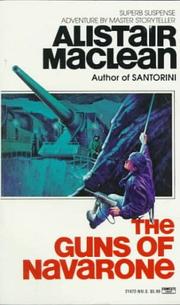
Start with The Guns of Navarone. It is not the best book MacLean wrote, but it is the one that defines the shape of everything else: a small team, an objective that cannot be reached, filthy weather, a traitor inside the group, and a plot that moves faster than any of the characters can think about it.
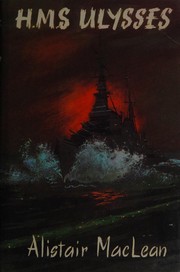
The obvious alternative is to begin at the beginning with H.M.S. Ulysses, his first novel and the one serious book in the catalogue. Read it second. It is a near-plotless account of an Arctic convoy being destroyed by weather, exhaustion and the Luftwaffe, drawn directly from MacLean's own war in the Royal Navy, and it is grim in a way nothing else he wrote is. As a sample of the thirty-odd books that followed it is actively misleading.
The core adventure novels
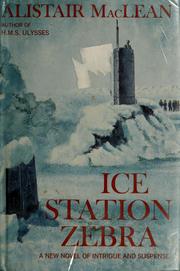
The Guns of Navarone (1957) sends five men up a cliff on a German-held Greek island to destroy two coastal guns. Where Eagles Dare (1967) is the formula at maximum concentration — a castle in the Bavarian Alps, a rescue that is not a rescue, and a double-cross roughly every forty pages; MacLean wrote it with a film already in mind and the film with Richard Burton and Clint Eastwood followed within a year. Ice Station Zebra (1963) puts a closed-circle murder mystery on a nuclear submarine under the polar ice. Night Without End (1959) does the same on the Greenland icecap after a plane crash. South by Java Head (1958), set during the fall of Singapore in 1942, is the strongest of the war novels after H.M.S. Ulysses and is much less known than it should be.
The 1960s thrillers
Fear is the Key (1961) opens with a courtroom escape and a car chase that runs for a quarter of the book and is still the best sustained action sequence he wrote. When eight bells toll (1966) is first-person, dry and sardonic, and set among the sea lochs of the west coast of Scotland. Puppet on a Chain (1969) is an Amsterdam heroin thriller and is markedly nastier than the rest of the catalogue, with torture and drug deaths on the page.
Sequels and the early 1970s
Force 10 from Navarone (1968) returns to two of the Navarone characters and is worth reading only if the first book worked for you; most readers find it thinner. Bear Island (1971) is another closed circle, this time a film crew in the Arctic. Breakheart Pass (1974) is a locked-room mystery set on a US Army train crossing 1870s Wyoming, and it is the last one that is unarguably good.
Where the books fall off, and how far
This is the part most reading orders leave out. MacLean was contracted to a novel a year, several of the later ones were written from film treatments rather than the other way round, and his health and drinking deteriorated through the 1970s. From roughly 1975 onwards the plots repeat, the dialogue turns into exposition delivered by interchangeable characters, and the set pieces stop landing. Circus, The Golden Gate, Seawitch, Goodbye California, Athabasca, River of Death, Partisans, Floodgate and San Andreas are named here in plain text rather than recommended. Santorini (1986), his last novel, is in this path so you can measure the drop yourself against The Guns of Navarone.
One more warning worth having. After MacLean died in 1987 a run of thrillers appeared branded with his name above the title, written by Alastair MacNeill and others from surviving outlines. They are shelved with the rest and they are not his books.
The life
Jack Webster's authorised biography, catalogued here simply as Alistair MacLean, is the one substantial account of him — Clydebank, the Royal Navy in the Arctic and the Far East, schoolteaching, sudden enormous success, and the long decline. It explains the pattern in the fiction better than any critical study, and it is honest about the drinking. Read it after five or six of the novels, not before.
If you want the wider tradition these books sit in, the Alistair MacLean hub collects what else is on the site.
Follow the full ordered path here: Alistair MacLean books in order: where to start.