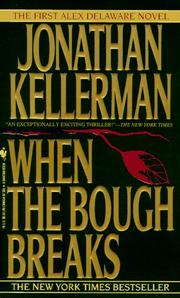
Start with When the Bough Breaks. It won the Edgar Award for best first novel, it is the shortest book in the run, and it is where the child psychologist Alex Delaware meets Milo Sturgis, the LAPD homicide detective who becomes the reason to keep reading. Everything else in the series is variations; this is the statement of the theme.
The alternative — jumping to a later, stronger book — is more defensible here than in most long series, because the mysteries are self-contained. But Alex's relationship with Robin, and more importantly the working friendship with Milo, develop continuously across the books, and the pleasure of the later novels is largely the pleasure of two people who have known each other for thirty years. Start at the start. Just do not feel obliged to finish; there are now more than forty of these.
The strong early run
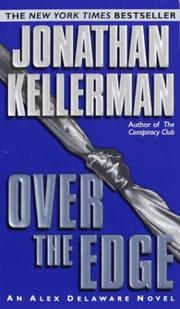
When the Bough Breaks, Blood test, Over the Edge (Alex Delaware), Silent partner, Time bomb, Private Eyes (Jonathan Kellerman) and Devil's Waltz are the first seven, and they are the series at its best. Kellerman practised as a child psychologist before he wrote fiction, and the early books use that expertise structurally rather than decoratively — the cases turn on how children are damaged and how institutions cover it up, and the psychology is doing real plot work. Silent partner and Devil's Waltz are the two most often named as the peak.
The mid-nineties
Bad love, Self-defense, The web and The Clinic are more uneven. The web is the genuine outlier: it moves Alex to a remote Pacific island, strands him without Milo, and abandons the format that makes the series work. Readers who skip exactly one book in this run usually skip that one. Bad love and The Clinic are solid returns to type.
Back on form
Survival of the fittest is a strong late-nineties entry with an unusually cold central premise, and the fourteenth book on this list, the one whose catalogue record is filed in lower case as monster, takes Alex inside a state hospital for the criminally insane. The murder book is the one to know about: a cold case that reaches back into Milo's own past, including his early years as a gay officer in an LAPD that did not want him. It is the most personal book in the run and a legitimate place to jump if the middle stretch loses you.
The gaps here
Two novels from this period are missing from our catalogue — Dr. Death and Flesh and Blood — and they sit between monster and The murder book, so this list is not a continuous numbered sequence at the end. The series has continued for more than twenty further novels beyond The murder book, none of them represented here.
Honest warnings
The formula is stable and openly so: Alex is consulted, Milo does the police work, the solution turns on a psychological motive, and the two of them eat at a lot of Los Angeles restaurants along the way. For readers of the genre that reliability is the appeal. For anyone else it becomes visible around book eight and never becomes invisible again. The early books are also period pieces of 1980s Los Angeles and read that way, including in their treatment of Milo's sexuality, which was progressive for 1985 and is handled with more ease by the 2000s.
Where to stop
Seven books gets you the best of it. Twelve gets you the best of it plus the two strongest later entries. Nobody needs all forty, and the series makes no argument that they should. More crime fiction is on Discover.
Follow the full ordered path here: Alex Delaware Reading Order: Where to Start with Jonathan Kellerman.
Ready to learn something deeply?
Build a reading path — free