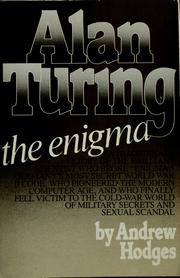
If you read one book, read Alan Turing by Andrew Hodges. Published in 1983, it is the definitive biography and remains so — Hodges is a mathematician, so the ideas are explained rather than gestured at, and he is a careful historian of Turing's life as a gay man in a country that criminalised him. It is long and it does not simplify. If that sounds like more than you want, Turing by B. Jack Copeland is a short Oxford introduction by the scholar who has edited most of Turing's papers, and it is the best brief life available.
A warning about the shelf itself, because it causes real confusion. Three different books here display under near-identical titles. Alan Turing by Andrew Hodges is the biography. Alan M. Turing is his mother Sara Turing's memoir. Alan Turing edited by S. Barry Cooper is a huge academic collection of Turing's papers. Always check the author before buying.
The other lives
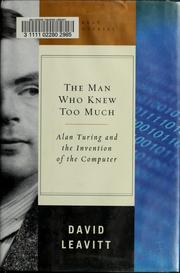
The man who knew too much by David Leavitt is a short biography by a novelist, part of a series pairing writers with scientific subjects. It is strong on Turing as a literary and cultural figure and on the trial and its aftermath; it is lighter on the mathematics, and readers who want the technical work explained will find Hodges or Copeland better.
Sara Turing's Alan M. Turing was published in 1959, six years after his death, by his mother. It is a protective book written when almost none of the relevant history could be discussed publicly — the wartime work was still secret and the conviction was not something a family wrote about. Read as a balanced life it fails; read as a primary document, written by someone who knew him from birth and who did not accept the coroner's verdict, it is genuinely valuable. The Cambridge reissue adds his brother John's memoir, which is franker.
The mathematics
This is the part most Turing books skip, and there are three routes through it at different levels. Turing's Vision by Chris Bernhardt explains the 1936 paper — computability, the universal machine, the halting problem — for readers with no more than school mathematics, and it is the gentlest genuine treatment available. The Annotated Turing by Charles Petzold is far more demanding: it reprints "On Computable Numbers" in full and walks through it essentially line by line, including the errors. Expect weeks, not evenings.
The Essential Turing, edited by Copeland, is Turing in his own words — the major papers on computability, cryptanalysis, artificial intelligence and morphogenesis, each with an editorial introduction that sets it in context. It is the book to own once you know why you want it.
Bletchley Park, and one persistent confusion
Station X by Michael Smith is the popular narrative history of Bletchley, brisk and organised around the codebreaking successes. The secret life of Bletchley Park by Sinclair McKay is the social history, built from interviews with surviving staff — what the work was like for the thousands of people, mostly women, who were not Turing.
Colossus, edited by Copeland, is an essay collection by the engineers and operators who built and ran the machine, and it corrects something almost everyone gets wrong: Colossus was Tommy Flowers' machine, built to attack the Lorenz cipher used for high-level German army traffic, not the Enigma. Turing's bombe was a different device against a different system, and Turing was not Colossus's designer. The book is the best available account of the actual hardware.
The codebreakers by David Kahn is the vast general history of cryptology across three millennia. Know which edition you have: the original 1967 text was written before the Ultra secret became public in 1974, so Bletchley is largely absent from it, and the revised edition adds material to cover that.
After Turing
Turing's cathedral by George Dyson is a fine book with a misleading title — it is about John von Neumann and the machine built at the Institute for Advanced Study, with Turing present mainly through the 1936 paper that made it conceivable. Read it as the sequel to the idea rather than a book about the man. Alan Turing edited by S. Barry Cooper and Jan van Leeuwen is the other endpoint: nearly a thousand pages of Turing's papers with commentaries by working scientists on what each one led to. It is a reference, not a read-through.
Follow the full reading path in order.
Follow the full ordered path here: Alan Turing Books: Which One to Read First, and in What Order.