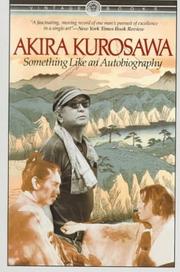
Begin with Something like an autobiography. Kurosawa's own account of his childhood, his brother, the 1923 earthquake and his apprenticeship in the studio system is superbly written and completely honest about its own limits — he ends it in 1950, at the moment Rashomon won at Venice, on the grounds that after that the films speak for him. So the entire body of work you probably came for is not in it, which is why this list continues.
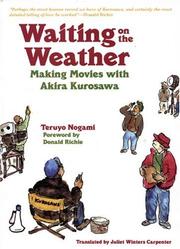
The second book solves half of that. Waiting on the Weather by Teruyo Nogami is a memoir by the woman who was his script supervisor from Rashomon onward and worked with him for four decades. It is the closest thing to a first-hand account of the later sets — the waiting, the weather, the temper, the crew — and it is affectionate without being reverent.
The two standard critical studies
The films of Akira Kurosawa by Donald Richie is the spine of English-language writing on the subject. Richie lived in Japan, knew Kurosawa, and works film by film through the whole career, which makes it the book to keep open beside the movies. It is also, by now, a historical document in its own right: Richie largely built the frame every later critic argues with.
The warrior's camera by Stephen Prince is the other standard study, and it is more theoretically committed — reading the films through Japanese political and social history, and unusually good on the late colour work that Richie's earlier editions could not cover. Between them they are the two critical books a serious reader owns.
One film at a time
Rashomon gets two books, of different vintages. Focus on Rashomon, edited by Richie, is a 1972 casebook — a collection of essays and documents assembled when the film was still being fought over. Kurosawa's Rashomon by Paul Anderer is recent and takes a different route entirely: it reads the film through Kurosawa's lost older brother Heigo, a silent-film narrator who killed himself, and through the vanished Tokyo of the 1920s. It is closer to biography than criticism.
Seven Samurai (BFI Film Classics) by Joan Mellen is a short monograph in the BFI series, the length of a long essay, and it is the model of what a single-film book should do. Ran is the published screenplay, worth having if you want to see how the Lear material was restructured before shooting.
The Emperor and the wolf by Stuart Galbraith is the enormous dual biography of Kurosawa and Toshiro Mifune, exhaustive on productions, release histories and the eventual rupture between them. It is a chronicle more than an interpretation, and it is the reference to reach for when you want a fact. Akira Kurosawa edited by Bert Cardullo is the collected interviews, useful precisely because Kurosawa repeats himself across decades and you can watch the story he tells about himself harden.
The scholarship that argues back
Kurosawa by Mitsuhiro Yoshimoto is the revisionist book, and it is worth the effort. Yoshimoto's argument is that Western criticism, Richie's very much included, constructed Kurosawa as the "most Western" of Japanese directors and read him through a humanist auteurism that flattened both the films and the Japanese context they came from. It is an academic book written in film-studies language and it is deliberately arguing with the books above it, not summarising them. Whether Yoshimoto is fair to Richie is itself debated; read them in that order and decide.
Akira Kurosawa and intertextual cinema by James Goodwin is the other academic study, on how the films rework Shakespeare, Gorky, Dostoevsky and American crime fiction.
For context, Richie's two survey histories close the path: A Hundred Years of Japanese Film is the broad chronological account, and Japanese cinema is his earlier, shorter survey of style and national character. Both put Kurosawa back among his contemporaries — Ozu, Mizoguchi, Naruse — which is where the strongest recent writing insists he belongs.
Follow the full reading path in order for the whole arc.
Follow the full ordered path here: Best Books About Akira Kurosawa, in Reading Order.