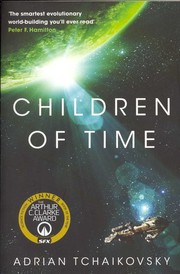
Start with Children of Time. It won the Arthur C. Clarke Award, it works completely on its own, and it is the clearest demonstration of the thing Tchaikovsky does better than almost anyone: taking a non-human intelligence seriously enough to build a civilisation out of it and then making you care about that civilisation's politics.
The alternative most people reach for — start at the beginning of the bibliography — is a mistake here, because the beginning is Empire in black and gold, the opening of a ten-book epic fantasy written early in his career. Tchaikovsky's output is not one arc; it is several unrelated sequences plus a shelf of standalones. Pick a sequence, not a year.
The Children of Time trilogy
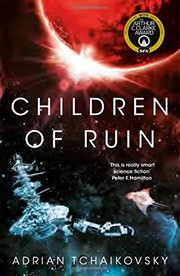
Children of Time follows a terraforming experiment that goes wrong in the most productive possible way, alternating between an ark ship of surviving humans and, on the planet below, several thousand years of spider evolution. Most readers find the spider chapters far stronger than the human ones; the ark-ship sections exist to give the alien timeline something to push against. Children of Ruin repeats the trick with octopuses and adds a genuinely unsettling parasite plot — it is the most body-horror-adjacent book he has written. Children of Memory is the odd one out: a puzzle-box structured around a failing colony and a repeated narrative, and it divides readers sharply. Nothing forces you past the first book, and Children of Time is a complete novel with a complete ending.
The Final Architecture trilogy
Shards of Earth, Eyes of the Void and Lords of Uncreation are straight space opera — crew of misfits, unknowable planet-destroying entities, faster pacing and lower conceptual ambition than the Children books. This is the sequence to read if you liked Children of Time but wanted more plot and fewer millennia. Read it in the order given; it is a single continuous story.
Dogs of War
Dogs of War is told partly by Rex, a bioengineered war dog who wants very badly to be a good dog, and it uses that voice to ask what legal personhood is for. Bear Head follows it years later in a colonised Mars setting and is the more conventional novel of the two. Start with Dogs of War; it stands alone.
The novellas
Elder Race is the best short entry point in his work: an anthropologist stranded on a low-technology world is mistaken for a wizard, and the book alternates between his account and the local one, running Clarke's third law from both directions at once. It takes an evening. Ogres is a shorter, angrier second-person fable about a world where the aristocracy are literally larger than everyone else. Either one tells you within an hour whether this writer is for you.
Shadows of the Apt
Empire in black and gold, Dragonfly falling, Blood of the mantis and Salute the dark are the first four books of Shadows of the Apt, and they form a complete war arc — you can stop after the fourth with a real ending. The setting is insect-kinden: human societies carrying the attributes of particular insects, in a world where an industrialising empire is rolling over city-states that still fight with magic. It is fun and inventive, and it is also his earliest published prose, noticeably rougher than everything above. The remaining six volumes — The Scarab Path, The Sea Watch, Heirs of the Blade, The Air War, War Master's Gate and Seal of the Worm — are not in our catalogue.
What is not here
Several of his best-regarded standalones are missing from this list, including Cage of Souls, The Doors of Eden, Guns of the Dawn, City of Last Chances, Alien Clay and Service Model. Their absence is a catalogue gap, not a judgement. Browse more science fiction on Discover.
Follow the full ordered path here: Adrian Tchaikovsky books in order: where to start.