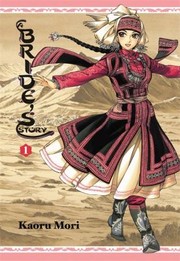
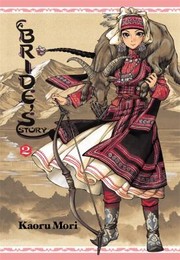
Start with A Bride's Story, Vol. 1. For once the obvious answer is the right one: the series runs in straight publication order, every volume continues directly from the last, and there is no prequel, side story or omnibus to complicate the entry point.
The question gets asked anyway, and there are two reasons why. The first is Mori's earlier series, which many readers found first — if you came in through Emma, Vol. 1, its Victorian London setting looks like it might connect. It does not. Different century, different continent, no shared characters. Read it for the same draughtsmanship, not for continuity. The second reason is that the middle of the series leaves its opening couple behind for a long stretch, and readers who did not expect that assume they have picked up the volumes out of order.
The opening: volumes 1 and 2
A Bride's Story, Vol. 1 introduces Amir, a twenty-year-old woman married into a settled family on the Central Asian steppe, and Karluk, her husband, who is twelve. The age gap is the premise, and it is worth saying plainly that some readers find it uncomfortable enough to stop there. Mori treats the marriage as an arrangement between clans in a specific historical setting rather than a romance to be cheered, and the drama comes from Amir's in-laws and her birth family rather than from the couple. Knowing that in advance helps.
A Bride's Story, Vol. 2 closes out the first crisis and settles the household. Together these two volumes work as a complete short story. If you only want a taste of Mori's work, stop here without guilt.
The travelling middle: volumes 3 to 8
From A Bride's Story, Vol. 3 onward the series becomes something closer to an anthology held together by geography. An English traveller and ethnographer, introduced early, sets off westward, and the narrative follows him instead of Amir. A Bride's Story, Vol. 4 continues that journey. A Bride's Story, Vol. 5 and A Bride's Story, Vol. 6 turn to a pair of twin sisters and their scramble toward marriage, which is the funniest sequence in the series and the least like the rest of it. A Bride's Story, Vol. 7 and A Bride's Story, Vol. 8 move into a Persian city and a much quieter register.
This is where readers stall. The volumes are excellent and they are not what the first two promised. Read them as a set of linked novellas about marriage across one region, and the shape makes sense.
The return and the long wait: volumes 9 onward
A Bride's Story, Vol. 9 and A Bride's Story, Vol. 10 bring the focus back to the steppe and to the family from the opening, with a real threat this time. A Bride's Story, Vol. 12 picks up the marriage arc that runs through the later books.
One honest note: volume 11 is missing from our catalogue, so it does not appear in the path. That gap is ours, not the publisher's — the volume exists in English and you should read it between 10 and 12.
The other honest note is that the series is not finished. Mori draws slowly, the historical detail in the panel backgrounds is the reason why, and volumes appear at long intervals. There is no ending to read toward yet, so treat each arc as its own reward rather than waiting for a resolution.
Browse more reading paths if you want something else in this vein.
Follow the full ordered path here: A Bride's Story Reading Order: Where to Start.