Start with First Shot, Last Call. There is no chronological alternative here and no clever shortcut: 100 Bullets ran for exactly 100 issues between 1999 and 2009, it was plotted as one slow reveal, and the collected volumes follow the issues in sequence. Publication order is the only order.
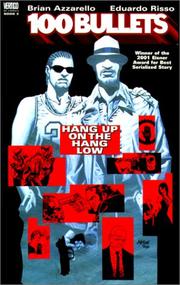
The tempting alternative is to open with the volume everyone names as the best. Volume three — published as Hang Up on the Hang Low, and stored in our catalogue under the plainer 100 Bullets Vol. 3 — is a self-contained Chicago story that stands up alone and is the usual answer to "which one is the good one". Read it third anyway. The early volumes look like an anthology and are in fact a shell game, and most of the pleasure of the back half depends on having been taken in by the front.
What the series actually is
Agent Graves approaches someone whose life has been wrecked and hands them an attaché case: a handgun, a hundred untraceable rounds, and documentary proof of who wrecked it. The rounds are legally invisible — use them and no investigation will touch you. For the first two volumes that premise generates standalone crime stories with a moral trapdoor in each. Then the frame turns out to be the plot. Graves is entangled with the Trust, thirteen families who carved up the New World between them centuries ago, and with the Minutemen, the enforcement arm the Trust created and then dismantled. By the midpoint the case-of-the-week has almost entirely given way to that history. Brian Azzarello wrote it, Eduardo Risso drew all 100 issues, and it collected multiple Eisner Awards along the way.
Volumes one to seven
First Shot, Last Call and Split Second Chance are the anthology stretch — sharp, brutal, thin on continuity. 100 Bullets Vol. 3 is where the dialogue stops being a stylistic tic and starts carrying the story. 100 Bullets Vol. 4, published as A Foregone Tomorrow, is the hinge: the Minutemen move to the centre and the book commits to being serialised. 100 Bullets Vol. 5 and 100 Bullets Vol. 6 consolidate that turn, and 100 Bullets Vol. 7 is where several long-running threads converge for the first time.
Volumes eight to eleven
100 Bullets, Vol. 8, 100 Bullets Vol. 9, 100 Bullets Vol. 10 and 100 Bullets Vol. 11 are the long approach to the endgame. This is the densest stretch of the run and the one readers most often stall in — the cast is large, the loyalties reverse repeatedly, and a scene will assume you remember a face from fifty issues earlier. Reading these four close together helps more than any recap.
The two volumes missing from this list
Volumes twelve and thirteen — published as Dirty and Wilt — have no usable record in our catalogue, so this path stops at eleven and does not include the ending. That is a gap in our data, not in the series. The clean workaround is to drop the thirteen-volume numbering altogether and read the collected editions: DC reprinted the entire run as 100 Bullets Book One through Book Five, with the conclusion in Book Five, and the five deluxe hardcovers do the same job. Pick one numbering scheme and stay inside it — mixing thirteen trades with five-book collections is how people end up buying the same issues twice.
Honest warnings
The violence is constant and deliberately unglamorous, sexual violence included, and the dialogue carries slurs in character voice throughout. Azzarello writes in heavy vernacular and withholds exposition on principle, so the first fifty pages can feel like eavesdropping on strangers. Risso's storytelling is the compensation and the reason most readers keep going.
Where to stop
There is no natural stopping point; it is one story with one ending. If the anthology structure of the first two volumes is not working for you, give it until 100 Bullets Vol. 4 — that is where the series shows its hand. If it still is not working, it will not start. More crime reading lives on Discover.
Follow the full ordered path here: 100 Bullets Reading Order: Where to Start Brian Azzarello's Crime Comic.