How to learn World War II
This curriculum takes a complete beginner from a vivid narrative understanding of World War II all the way to strategic, ideological, and historiographical mastery. Each stage builds on the last: first you absorb the human story, then the grand sweep of events, then the causes and decisions behind them, and finally the moral and scholarly debates that historians still wrestle with today.
The Human Story — Foundations
BeginnerBuild an emotional and chronological anchor for the war through accessible, narrative-driven accounts that make the period vivid and real before tackling history books.
▸ Study plan for this stage
Pace: 8–10 weeks total, reading roughly 20–25 pages per day. Suggested pacing: Anne Frank (3 weeks, ~300 pages) → Unbroken (3–4 weeks, ~400 pages) → With the Old Breed (2–3 weeks, ~270 pages). Allow 1–2 buffer days between books to reflect and journal before moving on.
- The civilian experience of occupation and persecution: Anne Frank's diary grounds the Holocaust in one Jewish family's daily terror, fear, and resilience inside the Secret Annex, making abstract statistics deeply personal.
- The psychological and physical limits of human endurance: Louie Zamperini's odyssey in Unbroken — from Olympic athlete to crash survivor to POW — illustrates how identity, faith, and willpower interact under extreme duress.
- The dehumanizing machinery of war on the front line: Eugene Sledge's memoir in With the Old Breed exposes the grinding, morally corrosive nature of Pacific island combat (Peleliu, Okinawa) from the perspective of an ordinary Marine.
- Chronological anchoring across theaters: reading the three books in order naturally spans the war's arc — European occupation (1942–44), Pacific air/sea war (1941–45), and Pacific ground combat (1944–45) — building a mental timeline.
- Perpetrator, victim, and combatant perspectives: the three narrators occupy radically different positions (Jewish teenager in hiding, American POW, U.S. infantryman), revealing how the same global conflict produced entirely different lived realities.
- Resilience, trauma, and the cost of survival: all three books honestly portray that surviving the war was not the end of suffering — Anne Frank does not survive; Zamperini battles PTSD and alcoholism; Sledge is haunted for life — establishing that 'victory' is morally complex.
- The role of recorded testimony: each book is a primary or near-primary source (diary, memoir, memoir), teaching the reader to read personal accounts critically — noting what the narrator can and cannot know, and why they chose to record their experience.
- After reading Anne Frank's diary, how did Nazi occupation policies — curfews, deportation orders, the yellow star — shape the Frank family's daily decisions inside the Secret Annex, and what does Anne's continued optimism reveal about human psychology under persecution?
- In Unbroken, what combination of factors — physical conditioning, mental strategies, relationships with fellow survivors — allowed Louie Zamperini to endure 47 days on a raft and years in Japanese POW camps, and where did those same factors fall short after the war ended?
- How does Eugene Sledge's account in With the Old Breed challenge any romanticized notion of combat heroism? What specific scenes or observations does he use to convey the moral and psychological cost of the Pacific island-hopping campaign?
- Across all three books, how does each narrator's sense of identity (Jewish girl, American athlete, Southern Marine) shape what they notice, record, and feel — and what blind spots might each perspective carry?
- What does the sequence of these three books reveal about the geographic and chronological scope of World War II? How do the European and Pacific theaters differ in the kind of suffering they imposed on civilians versus soldiers?
- All three narratives deal with dehumanization — of Jews by the Nazi state, of POWs by Japanese guards, of the enemy by U.S. Marines. How does each book portray this process, and what does it suggest about how ordinary people are conditioned to participate in or endure atrocity?
- Parallel timeline wall chart: As you read each book, plot key events from that narrator's life onto a single shared WWII timeline (e.g., Anne goes into hiding July 1942; Louie's B-24 crashes May 1943; Sledge lands on Peleliu September 1944). By the end of stage, you will have a visual, emotionally anchored chronology of the whole war.
- Empathy journaling — 'One Day in Their Shoes': After finishing each book, write a 1-page first-person journal entry imagining a single ordinary day as that narrator. Use only details the book actually provides. This forces close reading and emotional engagement with the source material.
- Vocabulary and context cards: Each time a historical term appears (e.g., 'Gestapo,' 'Geneva Convention,' 'banzai charge,' 'kamikaze'), write it on an index card with (a) the book's context, (b) a one-sentence historical definition, and (c) the theater/date it belongs to. Review the deck after each book.
- Comparative character analysis: After finishing all three books, create a simple three-column chart comparing Anne Frank, Louie Zamperini, and Eugene Sledge across five dimensions: their greatest fear, their coping mechanism, their relationship to the enemy, how the war ended for them, and their post-war fate. Look for patterns and contradictions.
- Map-based reading: Print or sketch a basic map of Europe and the Pacific. As you read, mark every location mentioned — the Secret Annex in Amsterdam, the raft's drift across the Pacific, the beaches of Peleliu and Okinawa. Annotating geography transforms abstract place names into a spatial understanding of the war's reach.
- Testimony reflection essay (500–700 words): After completing all three books, write a short essay answering: 'What can personal testimony tell us about World War II that a textbook cannot — and what can it not tell us?' Draw specific evidence from all three books to support your argument. This prepares critical reading skills for the next stage.
Next up: By having lived the war emotionally through three vivid personal testimonies — a hidden Jewish girl, a castaway POW, and a front-line Marine — the reader now has a human-scale emotional framework and a rough chronological skeleton onto which the next stage's more analytical, historian-authored accounts can hang facts, causes, and consequences with genuine meaning.
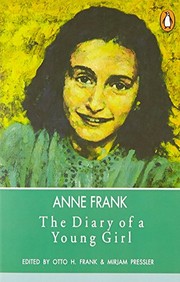
The most widely read primary source of the war; it immediately grounds the reader in the human cost of Nazi occupation and the Holocaust with zero prior knowledge required.
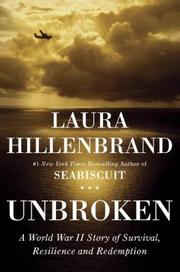
A propulsive, novelistic true story spanning the Pacific War, POW camps, and survival — it covers a different theater and builds chronological intuition for the war's full arc.

A Marine's unflinching memoir of Peleliu and Okinawa; reading a soldier's own words prepares the reader to evaluate military histories with a soldier's-eye perspective.
The Grand Narrative — What Happened and When
BeginnerAcquire a clear, complete chronological map of the entire war — all theaters, major turning points, and key figures — so later deep-dives have a framework to attach to.
▸ Study plan for this stage
Pace: 8–10 weeks total: Weeks 1–4 for Keegan's "The Second World War" (~25–30 pages/day, ~600 pages), then Weeks 5–10 for Hastings' "Inferno" (~20–25 pages/day, ~700 pages). Read Keegan first to build the structural skeleton, then use Hastings to flesh it out with human experience across all theaters.
- The war as a single interconnected global conflict — Keegan's framework of land, sea, and air power operating simultaneously across multiple theaters (Western Europe, Eastern Front, North Africa, Pacific, Atlantic)
- Chronological turning points: the Fall of France (1940), Operation Barbarossa (1941), Pearl Harbor (1941), Stalingrad (1942–43), El Alamein (1942), D-Day (1944), and the Pacific island-hopping campaign
- The role of coalition warfare — how the Allied alliance (Britain, USSR, USA) was forged, sustained, and strategically coordinated, as explored through both Keegan's operational lens and Hastings' ground-level accounts
- Military-strategic logic: Keegan's analysis of how geography, logistics, and industrial capacity shaped every major campaign decision, from Hitler's two-front overreach to Japan's resource-driven expansion
- The human cost and civilian experience of total war — Hastings' central argument that the war was defined as much by the suffering of ordinary soldiers and civilians as by the decisions of commanders
- Key figures and their strategic roles: Hitler, Churchill, Stalin, Roosevelt, Eisenhower, Zhukov, Rommel, MacArthur — understanding not just who they were but what decisions they made and why they mattered
- The concept of 'turning points' vs. 'inevitable outcomes' — both authors implicitly debate how much the war's result was determined by structural forces versus individual decisions and battlefield contingency
- Theater interdependence: how events in one theater (e.g., Lend-Lease, the North African campaign) directly enabled or constrained operations in another
- After reading Keegan, can you sketch a timeline from September 1939 to August 1945 and place at least 10 major events — across at least three theaters — in correct sequence and approximate date?
- How does Keegan explain Germany's early dominance (1939–1941), and what structural and strategic factors does he identify as the root causes of the eventual Axis collapse?
- Hastings argues that the war was experienced very differently depending on which front a soldier or civilian was on — what are three specific contrasts he draws (e.g., Western Front vs. Eastern Front, European theater vs. Pacific), and what do they reveal about the war's true nature?
- Who were the five most consequential military or political leaders covered across both books, and what single decision or failure is each most associated with?
- Both Keegan and Hastings cover the Eastern Front as the war's largest and most lethal theater — how do their treatments differ in emphasis (operational vs. human), and what do you learn from reading them together that neither provides alone?
- What does Hastings mean when he frames ordinary soldiers and civilians as the war's true protagonists, and how does this perspective complement or challenge Keegan's more command-and-strategy-focused narrative?
- Build a living timeline: As you read each book, maintain a single master document (paper or digital) with a column for date, event, theater, and book/page reference. By the end of Stage 1 you should have 40–60 entries spanning all theaters — this document becomes your anchor for all future stages.
- Draw a theater map from memory: After finishing Keegan, close the book and sketch a world map marking the six major theaters (Western Europe, Eastern Front, North Africa/Mediterranean, Atlantic, Pacific, Southeast Asia/Burma). Label the one or two decisive battles in each. Check against Keegan and correct errors — repeat after finishing Hastings.
- Write a 500-word 'commander's memo': Choose one major turning-point battle covered by both authors (e.g., Stalingrad or D-Day). Write a brief memo as if you are the commanding general the night before, summarizing the strategic situation, your objectives, and your greatest risk. This forces you to synthesize operational context from Keegan with the human stakes Hastings conveys.
- Conduct a 'Hastings vs. Keegan' compare-and-contrast log: Each time Hastings covers an event also described by Keegan, write two or three sentences noting what each author emphasizes and what the other omits. Aim for at least 8 entries. This trains the critical reading habit essential for later, more specialized books.
- Create a 'Key Figures' reference card: Build a one-page grid with columns for Name / Nation / Role / One Key Decision / One Key Failure. Populate it with at least 12 figures drawn from both books. Review and quiz yourself on it before moving to Stage 2.
- Stage-end self-assessment: Without notes, write a one-page narrative summary of the entire war — start to finish — covering all major theaters. Then re-read it against your master timeline and note any gaps or errors. These gaps are your personal reading agenda for Stage 2.
Next up: Having built a solid chronological and geographic skeleton of the entire war through Keegan's strategic architecture and Hastings' panoramic human portrait, the reader is now ready to zoom in — using Stage 1's framework as a map to navigate deeper, theater-specific or thematic deep-dives without losing the big picture.
Keegan's single-volume masterwork is the gold-standard overview for general readers; its clear prose and global scope give the reader a reliable mental map of the whole conflict.

Hastings weaves together hundreds of eyewitness accounts from every nation and theater, reinforcing Keegan's framework with vivid human texture and filling gaps in lesser-covered fronts.
Causes, Leaders, and Decisions — Going Deeper
IntermediateUnderstand why the war happened, how key leaders shaped its course, and how pivotal decisions were made — moving from 'what' to 'why' and 'how'.
▸ Study plan for this stage
Pace: 14–16 weeks total, divided across the three books: "The Rise and Fall of the Third Reich" (~1,250 pages) at ~35–40 pages/day over 5–6 weeks; "Absolute War" (~800 pages) at ~30–35 pages/day over 4–5 weeks; "No Simple Victory" (~400 pages) at ~25–30 pages/day over 2–3 weeks. Allow 1–2 buffer days per
- The structural and ideological roots of Nazism — how Weimar instability, economic collapse, and völkisch nationalism created the conditions Shirer chronicles in 'The Rise and Fall of the Third Reich'
- Hitler as decision-maker: how his personal ideology (Lebensraum, racial hierarchy, anti-Bolshevism) directly translated into strategic and operational choices, as traced throughout Shirer's narrative
- The Eastern Front as the war's decisive theater: Bellamy's 'Absolute War' reframes WWII around the Soviet-German struggle, showing how the scale of destruction and Soviet resilience shaped the entire conflict's outcome
- Stalin's leadership paradox — his catastrophic early purges of the Red Army versus his adaptive wartime command — as Bellamy presents the tension between ideological control and military necessity
- Total war and societal mobilization: both Shirer and Bellamy show how entire economies, populations, and cultures were weaponized, moving far beyond traditional military conflict
- Norman Davies's revisionist argument in 'No Simple Victory' — that Western historiography has systematically underweighted the Eastern Front and Soviet/Polish contributions, challenging the reader to interrogate their prior assumptions
- The role of contingency vs. inevitability: across all three books, pivotal moments (Barbarossa's launch date, Stalingrad, the Nazi-Soviet Pact) reveal how individual decisions and accidents of timing altered outcomes that seemed structurally determined
- Comparative leadership under pressure: contrasting Hitler's increasingly irrational micromanagement with Stalin's brutal but adaptive pragmatism and Churchill's coalition-building, synthesized across Shirer, Bellamy, and Davies
- According to Shirer, what combination of personal biography, institutional failures, and historical circumstances allowed Hitler to move from fringe agitator to absolute dictator — and at what point, if any, could the trajectory have been broken?
- Bellamy argues that 'Absolute War' was qualitatively different from warfare elsewhere in WWII. What specific military, ideological, and logistical factors made the Soviet-German conflict so uniquely destructive, and how did those factors interact?
- How does Davies's statistical and historiographical critique in 'No Simple Victory' force a re-evaluation of the conclusions drawn from Shirer's Western-centric perspective on the war's causes and outcomes?
- Across all three books, how did each major leader (Hitler, Stalin) use — and abuse — their command authority at critical turning points, and what do those decisions reveal about the relationship between ideology and military strategy?
- What does the Nazi-Soviet Pact, examined through both Shirer's political lens and Bellamy's military lens, tell us about the role of cynical realpolitik in causing and shaping the war?
- After reading all three books, how would you construct a multi-causal explanation for why the Allies won — one that honestly accounts for the relative contributions Davies insists have been overlooked?
- **Annotated Timeline:** As you read Shirer, build a running timeline of Hitler's key decisions (remilitarization, Anschluss, Barbarossa, etc.). After finishing Bellamy, annotate each entry with the Eastern Front consequences. After Davies, add a third layer noting where Western historiography has distorted or minimized each event. This living document will make the three books speak to each other.
- **Leadership Decision Log:** For each major turning-point decision covered across the three books, write a 150-word entry answering: (1) What were the realistic alternatives? (2) What ideological or personal factors drove the choice made? (3) What was the actual outcome vs. what was expected? Aim for at least 8–10 entries by the end of the stage.
- **Davies's Challenge Exercise:** After finishing 'No Simple Victory,' go back and select three specific claims or framings from Shirer that Davies would directly contest. Write a one-page 'historiographical dialogue' in which you steelman both authors' positions and then render your own verdict with evidence.
- **Map Work:** Using blank outline maps of Europe, trace the shifting front lines of the Eastern Front at six key moments Bellamy identifies (e.g., June 1941, December 1941, August 1942, February 1943, June 1944, May 1945). Annotate each map with the strategic decision that caused the shift — grounding Bellamy's narrative spatially.
- **Comparative Essay (500–700 words):** Write a structured response to the question: 'Was WWII primarily caused by the decisions of individuals or by structural forces beyond any one person's control?' Draw explicitly on evidence from all three books, ensuring each book contributes at least one concrete example.
- **Source Audit:** Shirer was a journalist and eyewitness; Bellamy is a military historian; Davies is a revisionist scholar. For each book, write a half-page 'source critique' assessing: What does the author's background and methodology allow them to see clearly? What might it cause them to miss or overemphasize? This trains the intermediate reader to treat primary arguments as evidence themselves.
Next up: By mastering the 'why' and 'how' of the war's causes, leadership, and pivotal decisions across these three books, the reader has built the analytical scaffolding needed to move into the next stage — examining the war's military campaigns, operational art, and on-the-ground experience with the critical eye of someone who already understands the ideological and strategic forces driving every battle.
The definitive popular history of Nazi Germany from its roots to its collapse; essential for understanding the ideological engine that drove the European war.
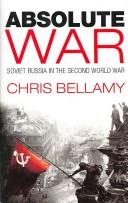
The Eastern Front — where the war was truly decided — is often under-covered in Western curricula; Bellamy's authoritative account corrects that gap before the reader goes further.
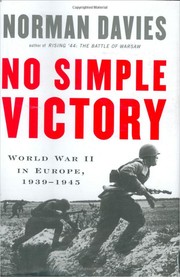
Davies challenges Western-centric assumptions about who fought and won the war, sharpening the reader's critical thinking before approaching advanced historiography.
Strategy, Command, and the Holocaust — Advanced Analysis
ExpertEngage with the war at the level of grand strategy, military command decisions, and the full historical reckoning with the Holocaust and its perpetrators.
▸ Study plan for this stage
Pace: 10–13 weeks total: ~3 weeks for "Ordinary Men" (~20–25 pages/day, 208 pp), ~4 weeks for "The Guns at Last Light" (~30–35 pages/day, ~896 pp), and ~3–4 weeks for "The Storm of War" (~30 pages/day, ~672 pp). Reserve the final week for review, comparative reflection, and completing exercises.
- Perpetrator psychology and the 'ordinary men' thesis: how situational pressure, conformity, careerism, and ideology combined — rather than fanaticism alone — to produce mass killers in Reserve Police Battalion 101
- The Holocaust as a bureaucratic and social process: the role of choice, peer pressure, and incremental escalation in genocide, as revealed by Browning's close reading of postwar testimonies
- Grand strategy in the European Theater: the Allied coalition's management of competing national interests, resource allocation, and the tension between the Mediterranean and cross-Channel strategies, as traced in Atkinson's Liberation Trilogy finale
- Operational and logistical mastery: how Eisenhower, Montgomery, Patton, and Bradley navigated supply crises (e.g., the Red Ball Express), the Hürtgen Forest, Market Garden, and the Battle of the Bulge in 'The Guns at Last Light'
- Command culture and leadership failure: Roberts's comparative analysis in 'The Storm of War' of Hitler's catastrophic strategic interventions versus Allied command flexibility and adaptability
- Hitler as his own worst enemy: Roberts's central argument that Nazi ideology — racial dogma, the Commissar Order, treatment of Soviet populations — structurally undermined German military effectiveness
- Coalition warfare and alliance management: how Churchill, Roosevelt, and Stalin balanced divergent war aims, as synthesized across both Atkinson and Roberts
- Historical reckoning and moral responsibility: integrating Browning's perpetrator-focused microhistory with Roberts's macro-strategic narrative to understand how the Holocaust was enabled and sustained within the wider war
- According to Browning, what combination of factors led the men of Reserve Police Battalion 101 to participate in mass killings, and why does he reject a purely ideological explanation? What does this imply about human behavior under institutional pressure?
- How does Atkinson portray the Allied command relationships — particularly between Eisenhower, Montgomery, and the national governments — in the final drive into Germany? Where did coalition friction most threaten operational success?
- What is Roberts's core thesis in 'The Storm of War' regarding Hitler's role in Germany's defeat, and which specific strategic decisions does he cite as most decisive? How does this compare with Atkinson's ground-level view of the same campaigns?
- How do Browning's findings about perpetrator motivation intersect with the broader strategic and ideological framework Roberts describes? In what ways did Nazi grand strategy and racial ideology mutually reinforce the machinery of the Holocaust?
- What logistical and operational lessons does Atkinson draw from the campaigns of 1944–45 — from Normandy's breakout to the Rhine crossings — and how did Allied commanders adapt when plans failed (e.g., Market Garden, the Bulge)?
- Across all three books, how is the concept of 'choice' treated — for individual perpetrators in Browning, for field commanders in Atkinson, and for Hitler in Roberts? What does each author's treatment reveal about historical agency and moral accountability?
- Perpetrator analysis essay: After finishing 'Ordinary Men,' write a 600–800 word response arguing either for or against Browning's situationist thesis. Use at least three specific episodes from the book (e.g., Major Trapp's offer, the Józefów massacre, the escalation over time) as evidence, then steelman the counterargument.
- Command decision map: While reading 'The Guns at Last Light,' create a running timeline/map of at least six major Allied command decisions (e.g., the broad-front vs. narrow-thrust debate, Market Garden approval, Bulge response). For each, note: who decided, what the alternatives were, and what Atkinson judges the outcome to be. Use a physical map or a free tool like Google My Maps to plot the geog
- Roberts vs. Atkinson comparative matrix: After completing both 'The Guns at Last Light' and 'The Storm of War,' build a two-column comparison table covering the same three or four campaigns (e.g., Normandy breakout, Market Garden, Battle of the Bulge, Rhine crossing). Note where the authors agree, where they diverge in emphasis, and what each author's analytical lens (operational journalism vs. gr
- Integrated synthesis paper: Write a 1,000–1,200 word essay answering: 'How did Nazi ideology simultaneously drive Germany's military strategy and enable the Holocaust?' Draw explicitly on Roberts's strategic argument, Browning's perpetrator evidence, and at least one logistical or operational example from Atkinson to show how the military and genocidal machines operated in parallel.
- Primary source dialogue: Select one postwar testimony excerpt cited by Browning and one strategic document or speech referenced by Roberts (e.g., Hitler's Commissar Order, a Führer directive). Write a one-page reflection on what each source reveals that a secondary narrative alone cannot, and what questions each source leaves unanswered.
- Reading journal — 'So what?' entries: For each of the three books, write a final 'So what?' journal entry (one per book, ~300 words each) addressing: What is the single most important thing this book changed or deepened in your understanding of WWII? How does it complicate a simpler story you held before?
Next up: This stage's command of grand strategy, perpetrator history, and coalition dynamics equips the reader to move into postwar reckoning, memory, and legacy studies — examining how the decisions and atrocities analyzed here were judged at Nuremberg, memorialized in culture, and continue to shape geopolitics and moral philosophy.
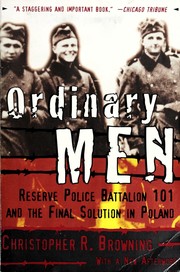
A landmark work of Holocaust scholarship examining how ordinary people became mass killers; it forces the reader to grapple with the deepest moral questions of the war.
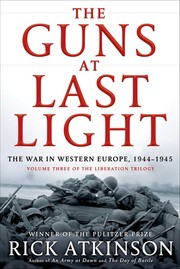
The final volume of Atkinson's Liberation Trilogy delivers a masterclass in operational military history, showing how grand strategy, logistics, and command interact at the highest level.
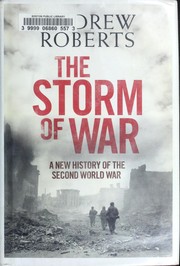
Roberts synthesizes the entire conflict through the lens of strategic decision-making and Hitler's fatal errors, providing an ideal capstone that ties together everything learned across the curriculum.
Discussion
Keep reading
Paths that share books, cover the same subject, or open a related topic.