Watchmaking: from first tick to finished movement
This curriculum takes a hands-on hobbyist from zero knowledge to confident bench work across four progressive stages. Each stage builds on the last — starting with how watches work conceptually, moving into the language and tools of the trade, then into practical servicing, and finally into the advanced craft of movement assembly and construction.
Foundations: How Watches Work
BeginnerUnderstand the mechanical principles behind a watch — escapements, gear trains, and timekeeping — so that every later hands-on step has a conceptual anchor.
▸ Study plan for this stage
Pace: 6–8 weeks total. Week 1–2: Read "The Watch, Thoroughly Revised" by Gene Stone cover to cover (~20–25 pages/day), treating it as an accessible orientation to watch culture, terminology, and basic mechanics. Weeks 3–8: Work through "Watchmaking" by George Daniels at a slower, more deliberate pace (~10
- The power source and mainspring: how a wound spring stores and releases energy through the gear train
- The gear train: how a series of wheels and pinions transmits and reduces the mainspring's energy into controlled, countable motion
- The escapement mechanism: how the escape wheel and pallet fork divide continuous rotational energy into discrete, regulated 'ticks'
- The balance wheel and hairspring: how their oscillation acts as the watch's timekeeping regulator, and what affects beat rate (amplitude, isochronism)
- The going train vs. the motion works: distinguishing the power-transmission side from the time-display side of the movement
- Jewels and their functional role: why synthetic rubies are used at pivot points to reduce friction and wear
- Daniels' philosophy of watchmaking as a discipline: precision, patience, and understanding the 'why' behind every component before touching it
- Basic movement taxonomy: differentiating lever escapements, detent escapements, and the co-axial escapement as introduced by Daniels
- After reading Gene Stone, can you explain in plain language — to someone who has never opened a watch — how a mechanical watch keeps time from the moment the crown is wound to the moment the hands move?
- What is the role of the escapement, and why would a watch run fast or slow if the escapement were improperly adjusted? (Ground your answer in Daniels' technical descriptions.)
- George Daniels places enormous emphasis on understanding a component's purpose before attempting to work on it. What specific examples does he give to illustrate why conceptual knowledge must precede hands-on work?
- How does the hairspring's geometry and material properties affect isochronism, and why does Daniels treat this as one of the most critical relationships in the entire movement?
- What distinguishes the Swiss lever escapement from the co-axial escapement Daniels developed, and what problem was Daniels trying to solve?
- Using the gear-train ratios discussed by Daniels, how does the movement translate the mainspring's slow unwinding into the precise 28,800 (or other) vibrations per hour of the balance wheel?
- Diagram from memory: After finishing Gene Stone, draw a simple flow diagram of energy through a watch — mainspring → barrel → gear train → escapement → balance wheel → hands. Label each stage with one sentence describing its function. Revisit and refine this diagram after each major chapter of Daniels.
- Terminology flashcards: As you read Daniels, create a physical or digital flashcard for every new component (e.g., pallet fork, impulse face, draw angle, beat error). Write the term on one side and both a definition AND its functional relationship to adjacent parts on the other.
- Watch dissection video shadowing: Find a reputable slow-motion disassembly video of a common movement (e.g., ETA 6497 or similar lever-escapement movement). Pause at each component and locate the corresponding passage in Daniels before continuing. Do not touch a real watch yet — this is purely observational.
- Escapement simulation: Use a free online escapement animation (e.g., the Cousins UK or NAWCC interactive tools) and, with Daniels open beside you, identify every part shown, trace the locking, impulse, and recoil actions, and write a one-paragraph description of one full tick-tock cycle in your own words.
- Concept self-quiz at chapter boundaries: After every chapter of Daniels, close the book and write answers to two questions: (1) What is the single most important principle this chapter taught? (2) How would a watchmaker's work go wrong if they ignored this principle? Compare your answers to the text.
- Annotated re-read of key Daniels passages: Select three passages from Daniels that you found most difficult on first reading. Re-read each one slowly and write marginal annotations explaining every sentence in simpler language, drawing small sketches where helpful. This forces active processing of the densest technical content.
Next up: By internalizing how every component in a mechanical watch functions and interrelates — as laid out conceptually by Stone and technically by Daniels — the reader arrives at the next stage (hands-on disassembly and assembly) with a mental model that transforms unfamiliar parts into expected, named actors, making the first real tool-in-hand experience purposeful rather than exploratory guesswork.

A beautifully accessible introduction to the world of mechanical watches — their history, anatomy, and appeal — giving the beginner a broad mental map before diving into technical detail.
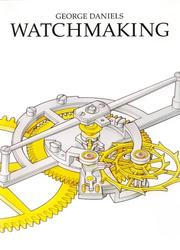
The canonical masterwork by the greatest modern watchmaker. Read it first at a high level to absorb vocabulary, the logic of movement design, and what mastery looks like — you will return to it repeatedly in later stages.
The Watchmaker's Language & Tools
BeginnerLearn the precise terminology, hand tools, and bench setup used by working watchmakers so you can read technical literature and begin safe disassembly.
▸ Study plan for this stage
Pace: 6–8 weeks total. Week 1–3: Read "The Watch Repairer's Manual" by Fried at roughly 15–20 pages/day, pausing to cross-reference any unfamiliar term in the glossary before moving on. Week 4–8: Read "Practical Watch Repairing" by De Carle at 12–18 pages/day, treating its heavily illustrated chapters as
- Watch anatomy vocabulary: Fried's systematic naming of every part — mainspring, barrel, click, ratchet wheel, cannon pinion, jewels, pallet fork, escape wheel, balance wheel, hairspring — and De Carle's illustrated cross-sections that give those names a visual anchor
- Tool identification and correct usage: bench keys, pegwood sticks, tweezers (AA, 2, 3, 5 grades), case-opening knives, hand-removers, movement holders, and the oilers and oil cups described and pictured in both books
- Bench setup and discipline: the layout principles Fried establishes for a clean, organized watchmaker's bench — tray use, parts organization, lighting, and the habit of working over a bench mat to catch dropped components
- Safe disassembly sequence: the logical order of operations Fried outlines (crown/stem removal, dial and hands off, movement extraction) and De Carle's reinforcement of why sequence prevents damage
- Measurement and fit: understanding how Fried introduces the ligne (''') and millimeter as the watchmaker's units of size, and how De Carle applies them when selecting replacement parts
- Lubrication fundamentals: the distinction between clock oil, watch oil, and grease; where each is applied; and why over-oiling is as damaging as no oil — a theme running through both authors
- Reading technical literature: how both Fried and De Carle use exploded diagrams, parts lists, and manufacturer caliber references, training you to decode any technical manual you encounter later
- Workshop safety and part preservation: Fried's and De Carle's shared warnings about magnetism, dust, skin oils on parts, and the correct storage of delicate components between sessions
- Can you name and point to at least 20 individual movement parts using the terminology established by Fried, and verify each against De Carle's illustrations?
- What is the correct order for removing the hands, dial, and movement from a pocket or wristwatch case, and what tool does each step require according to Fried?
- What is a ligne, how does it relate to millimeters, and why does De Carle rely on this unit when describing movement sizes?
- Which grade of tweezers is appropriate for handling a hairspring versus a mainspring, and what bench habits do both authors recommend to avoid springing or kinking delicate parts?
- Where are the five primary lubrication points on a going-train movement, what type of lubricant belongs at each, and what does Fried say happens when the wrong oil is used?
- How do Fried's written descriptions and De Carle's photographic/diagrammatic approach complement each other, and how would you use both books together to identify an unfamiliar part on a movement you have never seen before?
- Build a living glossary: as you read each chapter of Fried, write every new term on an index card with a hand-drawn sketch; when you reach the same term in De Carle, add the page number and note any differences in description or emphasis
- Tool handling drill: lay out every tool mentioned in Fried's opening chapters on your bench mat, pick each one up with proper grip, name it aloud, and state its purpose before setting it down — repeat until fluent
- Blind identification: study De Carle's exploded movement photographs, then cover the captions and attempt to label every visible part using only Fried's terminology; score yourself and review misses
- Supervised disassembly log: using a scrap pocket-watch movement (a common pin-lever or dollar-watch caliber), follow Fried's disassembly sequence step by step, writing down each action, the tool used, and any resistance or surprise encountered before consulting De Carle's photos for confirmation
- Lubrication map: draw a top-down schematic of a simple movement and, using both books as references, annotate every lubrication point with the correct oil type, approximate quantity ("one oiler tip"), and the consequence of omission described by either author
- Bench setup audit: photograph your bench before and after reorganizing it according to the principles in Fried; write a one-paragraph reflection on which habits De Carle's practical tips reinforced or changed
Next up: Mastering Fried's terminology and De Carle's visual parts identification gives you the shared language and safe-hands discipline needed to follow the more mechanically detailed disassembly, cleaning, and reassembly procedures that form the core of the next stage.

The classic American bench reference, written for the self-taught repairer. Its systematic coverage of tools, parts nomenclature, and basic procedures makes it the ideal first practical text.
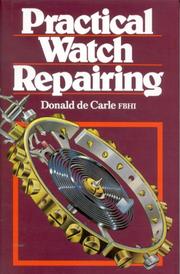
De Carle's step-by-step style and clear illustrations build directly on Fried's vocabulary, walking the reader through a complete service from case opening to regulation — the perfect companion for your first teardowns.
Bench Skills: Servicing & Diagnosis
IntermediateDevelop the hands-on competence to fully service common lever-escapement movements, diagnose faults, replace worn parts, and regulate a watch to acceptable timekeeping.
▸ Study plan for this stage
Pace: 10–13 weeks total. Book 1 ("Clock and Watch Escapements" by Gazeley): 5–6 weeks at ~20–25 pages/day, reading analytically with diagrams — pause frequently to sketch escapement geometry. Book 2 ("Repairing Old Clocks and Watches" by Whiten): 5–7 weeks at ~15–20 pages/day, reading at the bench with to
- Lever-escapement geometry and the roles of every surface: impulse faces, locking faces, draw angle, and guard pin — as dissected in Gazeley's detailed escapement analysis
- The relationship between escapement lock, drop, and run, and how mis-adjustment of each produces specific timekeeping errors (Gazeley chapters on escapement faults)
- Pallet-fork and escape-wheel tolerances: how to measure and assess wear on pivot holes, pallet stones, and escape-wheel teeth using Gazeley's measurement criteria
- Full strip-down and reassembly sequence for a lever-movement: the correct order of operations, handling discipline, and part-storage practice as laid out by Whiten
- Cleaning methods and their rationale — ultrasonic, peg-wood, and hand-cleaning — together with correct lubrication points, oil grades, and quantities described by Whiten
- Fault diagnosis workflow: using Whiten's systematic approach to trace symptoms (stopping, erratic rate, loud tick, power loss) back to root causes before touching the movement
- Mainspring inspection, let-down procedure, and replacement: assessing set, corrosion, and correct barrel fit per Whiten's guidance
- Regulation and rate adjustment: using the index lever and timing instruments (or a timing machine) to bring a movement within acceptable daily-rate limits, as covered by Whiten
- After reading Gazeley, can you explain — without the book — what 'draw' is, why it is built into the lever escapement, and what happens to the watch's security if draw is insufficient or excessive?
- Gazeley describes how to calculate and verify correct lock depth. What is the consequence of too little lock versus too much lock on both timekeeping and escapement safety?
- Using Whiten's fault-diagnosis framework, a watch runs for 30 minutes then stops. Walk through the logical sequence of checks you would perform and name at least four possible causes.
- Whiten details lubrication as a critical step. Which escapement surfaces must NOT be oiled, which must receive a specific grade of oil, and what is the risk of over-oiling the pallet stones?
- Describe the correct mainspring let-down procedure from Whiten. Why is skipping this step before disassembly potentially destructive to the movement?
- Having worked through both books, how does a worn or chipped escape-wheel tooth (a geometry problem from Gazeley) manifest as a practical symptom you would observe on the bench (as described by Whiten)?
- Escapement drawing drill (Gazeley): After each chapter on lever-escapement geometry, close the book and freehand-draw the pallet fork, escape wheel, and banking pins in three positions — locked, impulse, and drop. Label every surface Gazeley names. Compare to the book's diagrams and repeat until all labels are correct from memory.
- Dead-beat observation (Gazeley): Obtain a scrap or practice lever movement. Using a loupe or stereo microscope, locate each feature Gazeley describes — impulse face, locking face, guard pin, safety dart — and verify draw angle visually by gently pushing the fork and watching it spring back. Record your observations in a bench notebook.
- Timed strip-down and reassembly (Whiten): Following Whiten's sequence exactly, fully disassemble a common 17-jewel lever movement (e.g., ETA 6497 or similar), placing every part in a parts tray in removal order. Reassemble without forcing any part. Repeat three times, aiming to reduce errors each run and logging any parts handling mistakes.
- Fault-injection diagnosis (Whiten): With a running practice movement, deliberately introduce one fault at a time (e.g., remove a drop of oil from a pallet stone, slightly over-bank the fork, introduce a hair in the barrel). Observe the symptom, then use Whiten's diagnostic logic to identify the cause before inspecting — testing whether your diagnosis matches the planted fault.
- Lubrication audit (Whiten): After reassembling a movement, create a hand-drawn lubrication map of the movement identifying every point Whiten specifies, the oil grade required, and the application method. Perform the lubrication step-by-step against this map, then have a more experienced watchmaker or a reference photo verify your oil spots under magnification.
- Rate regulation log (Whiten): Place a freshly serviced movement on a timing machine (or use a smartphone timing app) in six positions (dial up, dial down, crown up, crown down, crown left, crown right). Record the rate in each position, adjust the index, and repeat until the movement achieves a mean daily rate within ±30 seconds/day. Document every adjustment in a bench log to build intuition for
Next up: By mastering escapement theory through Gazeley and translating it into repeatable bench practice through Whiten, the reader has the diagnostic vocabulary and physical discipline needed to tackle more complex calibers, complications, and the finer tolerances demanded at the advanced restoration and adjustment stage.

A deep, practical treatment of the lever, cylinder, and other escapements — the heart of any mechanical watch. Understanding escapement geometry at this level is essential before attempting escapement adjustments at the bench.

Bridges theory and repair practice with a strong focus on diagnosis and fault-finding, reinforcing the problem-solving mindset a hobbyist needs when facing an unfamiliar movement.
Discussion
Keep reading
Paths that share books, cover the same subject, or open a related topic.