Tintin Reading Order: Where to Start and Which Albums to Skip
Hergé's twenty-four Tintin albums are almost never read in publication order by anyone who enjoys them, because the first two are the weakest and the most compromised — Land of the Soviets is crude propaganda and Tintin in America is barely a story. This path starts where the series becomes good, keeps the linked pairs together, and is explicit about which albums our catalogue can and cannot link separately: a large number of Tintin books exist here only as French-language packages or three- and four-album omnibuses, so several famous titles are named rather than listed.
The best entry points
BeginnerStart with the albums where Hergé's plotting and the ligne claire style arrive together, and meet Haddock.
▸ Study plan for this stage
Pace: Two weeks, and slow down more than the page counts suggest. These three total 220 pages — 96 for The Crab with the Golden Claws and 62 each for the other two — and a 62-page Tintin album looks like ten minutes and is nothing of the sort. Hergé works at twelve or more panels a page, every one of them
- Ligne claire: uniform line weight, flat colour, no hatching — and why that makes dense pages readable rather than cluttered
- Haddock as the transformation of the series, supplying the temperament Tintin lacks
- Panel density as a reading-speed problem: what a 62-page album actually contains
- Hergé's plotting at its tightest in The Black Island, a thriller with no continuity requirements
- The Broken Ear as the first album with a political argument rather than a set of incidents
- Publication order declined: why starting where the series becomes good is the standard advice
- What does Haddock supply that Tintin cannot, and how quickly does The Crab with the Golden Claws establish it?
- Count the panels on three pages of The Black Island. What does that density let Hergé do with pacing?
- How does ligne claire keep a crowded panel legible? Identify the specific techniques — colour separation, outline, staging.
- What is The Broken Ear satirising, and how directly does the album name its targets?
- Which of these three would you hand to a new reader, and does your answer differ from this path's ordering?
- Read one album twice — once for the story, once looking only at backgrounds, vehicles and crowds. Hergé's detail is the reason these books survive rereading, and the second pass is where you find it.
- Take a single page and count the panels, then time how long the page takes you properly. Multiply out: that is what a 62-page album actually costs, and it is the planning number for the whole path.
- Track Haddock's introduction scene by scene in The Crab with the Golden Claws and note how long Hergé takes to make him likeable rather than merely funny.
- List what The Broken Ear says about who profits from a coup. It is a children's album with an argument, and stating the argument is the exercise.
Next up: With Haddock established and Hergé's plotting at full strength, the next stage takes on the two-part stories, which are single narratives split across two albums.

The single best starting album: it introduces Captain Haddock, who transforms the series from a boy reporter's adventures into a double act. Everything before it is optional; nothing after it works as well without him.

A tight, fast thriller set in Scotland and the cleanest demonstration of Hergé's plotting. A good second album because it needs no continuity at all.

The South American political satire, and the first album with genuine moral weight. Catalogued as Tintin and the Broken Ear; it is the same book.
The pairs that must be read together
BeginnerRead the two-part stories in sequence, since each is one narrative split across two albums.
▸ Study plan for this stage
Pace: Three to four weeks, and two errands before you start. Red Rackham's Treasure is 80 pages; no page counts are recorded in our catalogue for The Secret of the Unicorn, Prisoners of the Sun or Explorers on the Moon, but all are standard albums and each is an afternoon at the density described in the l
- The two-part album as one narrative split for serialisation, and the reading consequences of treating either half as standalone
- Marlinspike introduced in the Unicorn story, giving the series a home it returns to for the rest of the run
- Calculus introduced in Red Rackham's Treasure, completing the ensemble
- Hergé's research method at its most visible in the moon story — the engineering is worked out rather than gestured at
- Two supply gaps at the first halves of two pairs, which have to be filled elsewhere for the second halves to make sense
- Adventure plotting built on a document, a treasure or a device rather than on a villain
- Where does The Secret of the Unicorn break off, and what does the split cost or gain compared with a single long album?
- What does Marlinspike do for the series, structurally, once Tintin has somewhere permanent to return to?
- How does Calculus change the ensemble's comedy, and what does he make possible in the plots?
- How much of the moon story's engineering is actually correct, and where can you see Hergé having worked it out rather than invented it?
- The Inca and moon stories are both two-parters. Do they split at comparable points, and does one manage the break better?
- Source The Seven Crystal Balls and Destination Moon before starting this stage. Libraries hold them widely; both are prerequisites rather than optional extras.
- Read each pair on consecutive days and note where the first album's cliffhanger sits. Serialised breaks rarely fall on the story's own joints.
- Take the rocket sequences in Explorers on the Moon and check two or three of the technical details against what was actually known at the time it was drawn. Hergé's accuracy is checkable and the exercise is the point of the album.
- Draw the ensemble as it stands at the end of this stage — Tintin, Haddock, Calculus, the Thompsons, Marlinspike — and note which album added each. The later albums are built on that roster.
Next up: The full ensemble and the family house are in place, which is precisely what the late albums need in order to stop being adventures and start being character pieces.

The first half of the Red Rackham story and the introduction of Marlinspike. Never read alone — it ends mid-plot by design.

The direct conclusion, and the album that introduces Professor Calculus. Read immediately after The Secret of the Unicorn.

The second half of the Inca story. Its first half, The Seven Crystal Balls, has no English record we can link — our catalogue returns only a French book-and-DVD package — so read that first from your own copy or a library, or this album opens on an unexplained kidnapping.

The second half of the moon story and one of the finest things Hergé drew, with genuinely careful engineering. Its first half, Destination Moon, is likewise only available here as a French package — read it first if you can, since this album assumes the rocket already exists.
The mature albums
BeginnerRead the late books where Hergé stops writing adventures and starts writing character pieces.
▸ Study plan for this stage
Pace: Three weeks. Tintin in Tibet and The Castafiore Emerald are 62 pages each, 124 between them, and no page count is recorded in our catalogue for The Calculus Affair, which is a standard album. Read them in the listed order and read them slower than the earlier stages, not faster: these are the albums
- Misdirection as plot engine in The Calculus Affair — the reader chasing the same wrong things the characters do
- An adventure story with no antagonist, and what Tintin in Tibet substitutes for one
- Friendship as subject matter, which is the late Hergé's actual interest
- The Castafiore Emerald as formal experiment: a full album of interruptions, false alarms and non-events
- A single location doing the work a globe-spanning plot used to do
- Why these three are the albums adults return to, and the earlier ones the albums children love
- How does The Calculus Affair keep a chase legible while withholding its own object? Track what you believe is happening at three points.
- What replaces the villain in Tintin in Tibet, and what does the album gain by having none?
- What is the joke in The Castafiore Emerald, and who is it on — the characters, the genre, or the reader?
- What does Hergé do with Marlinspike as a single setting that a travel plot could not?
- Are these three genuinely better than the entry-point albums, or better for a different reader? Argue from specific pages.
- Read The Calculus Affair once, then reread the first fifteen pages knowing the answer. The misdirection is constructed, not accidental, and the second pass shows the construction.
- In Tintin in Tibet, find the pages where nothing is said. Hergé rarely gives up dialogue and where he does is where the album's argument is.
- Count the interruptions in The Castafiore Emerald — every time something is about to happen and does not. The number is the album's structure.
- Rank all nine albums you have read on this path and write one sentence for the top and bottom placements. This is the list every Tintin reader eventually makes.
Next up: Having read the series at its best, the last stage goes back to its worst — for context rather than for pleasure.

The best-plotted album in the series and the most purely thrilling — a Cold War chase built almost entirely out of misdirection. Read after the pairs, since it relies on you already knowing Calculus.
The album Hergé considered his best, with no villain at all — just a rescue and a friendship. Our record displays the title with an accent as Tintín in Tibet; the text is the standard English album.
A comedy in which nothing happens, set entirely at Marlinspike, and the most formally daring thing in the series. Read it last of the strong albums — it is a joke at the expense of every adventure that came before.
Where the series starts, and why to skip it
BeginnerRead the notorious first album for context rather than pleasure, and know what the rest of the run holds.
▸ Study plan for this stage
Pace: One evening, read as a document. Tintin in the Land of the Soviets is 141 pages, longer than the standard albums because it is the original black-and-white serial format rather than a redrawn colour album, and it reads much faster than a mature Tintin because the pages are sparse and the plotting is
- The 1929 original as serial newspaper work: black and white, sparse pages, no album structure
- Openly propagandistic content, commissioned and published as such
- The distance between the first album and the mature ones, measurable in drawing, plotting and politics
- The Blue Lotus as the documented turning point in Hergé's research and his treatment of foreign settings
- Omnibus packaging as a catalogue problem: three albums in one record, so the individual titles cannot be linked
- Reading an early work for evidence rather than for pleasure, and the difference that makes to how you read
- What is Land of the Soviets arguing, and how is the argument delivered — through plot, through caption, or through caricature?
- How does the 1929 page differ from a mature album page in panel count, staging and use of white space?
- What is missing from this album that the later ones have — and is any of it present in embryo?
- What changed with The Blue Lotus, and why is that album usually named as the turning point?
- Having read the good albums first, did reading this one add anything? Answer honestly; the stage is built to permit no.
- Put a page of Land of the Soviets beside a page of The Castafiore Emerald and describe every difference you can see. The gap is the clearest single demonstration of what Hergé learned.
- Seek out The Blue Lotus in print, since this path cannot link it separately. It is the most important album not on the list above and the one that shows the change this stage is about.
- Write down what Land of the Soviets asserts about its setting, then note where it offers evidence for any of it. The absence is the point of reading it as a document.
- Finish by writing your own recommended Tintin order for a new reader: where to start, which pairs to keep together, which albums to source separately, and whether the early ones are worth their time at all.
Next up: This is the end of the path: the series entered where it becomes good, the two-part stories kept together, the mature albums read last among the strong ones, and the first album placed where it belongs — as evidence, after the fact.
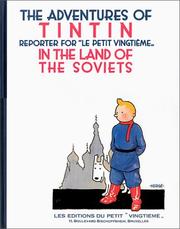
The first album, drawn in 1929, crude and openly propagandistic — worth reading only after the good ones, as evidence of how far Hergé travelled. Tintin in America, the other weak early album, has no separate record here; it appears only inside a three-album omnibus alongside Cigars of the Pharaoh and The Blue Lotus, so those three are named rather than listed above. The Blue Lotus in particular is a major album and worth seeking out in print.