The history of Chile: books to read, in order
Chile spent most of the nineteenth and twentieth centuries with a reputation for constitutional stability that made what happened in 1973 seem impossible, and the country has been arguing about that ever since. The shape of the history is legible: a long oligarchic republic funded first by nitrate and then by copper, a slow widening of the electorate that brought the left to power by increments, the Popular Unity government of Salvador Allende attempting a socialist transformation by strictly legal means, a coup, seventeen years of dictatorship under Augusto Pinochet with over three thousand killed or disappeared and tens of thousands tortured, a radical free-market restructuring carried out under that dictatorship, and a negotiated transition back to democracy that left the constitution and much of the economic model in place. The disputes are about causation and responsibility: how much the United States did, whether Allende's government was destroyed or collapsed, whether the economic model was worth its cost, and whether a transition that left Pinochet as senator-for-life was prudence or capitulation. This path is ordered so you meet each of those arguments with the evidence already in hand.
The Republic Before 1970
BeginnerEstablish the long national history. By the end you should be able to explain the nitrate economy and the War of the Pacific, the shift to copper and foreign ownership, the rise of organised labour and the Popular Front, and how the electoral left grew steadily across the 1950s and 1960s.
▸ Study plan for this stage
Pace: One book, 427 pages: Simon Collier's A history of Chile, 1808-1994, written with William Sater, the standard English-language survey from independence to the early transition. Three weeks at 30 pages a session, and do not rush it or skip ahead. It is dry and comprehensive and it is the necessary spi
- The nitrate economy, its foreign ownership, and the state revenue it produced
- The War of the Pacific and the territory it gained
- The shift from nitrate to copper, and copper's ownership by American companies
- The oligarchic parliamentary republic and the limits of its franchise
- Organised labour, the nitrate camps, and the massacres that shaped Chilean union memory
- The Popular Front and the entry of the left into governing coalitions
- The steady expansion of the electorate across the mid-century and the left's incremental growth
- A three-way party system — right, centre, left — and why the centre's position was decisive
- How did nitrate revenue shape the nineteenth-century Chilean state?
- What changed when copper replaced nitrate as the country's principal export?
- What was the Popular Front, and what did the left gain by joining it?
- How did the electorate expand between the 1930s and the 1960s, and who was added?
- Describe the three-bloc party system and explain why the centre held the balance.
- What in this history makes Chile's reputation for constitutional stability accurate, and what makes it misleading?
- Chart the left's share of the vote across every presidential election Collier covers from the 1930s onward. The trend line is the argument.
- List the foreign companies that owned Chilean nitrate and copper and note what proportion of export earnings each controlled.
- Write down the position of the Christian Democrats and their predecessors at each mid-century election. You are tracking the centre because the centre is what breaks.
- Summarise Chilean labour history from the nitrate camps to 1970 in one page, keeping the massacres and the union structures both on it.
Next up: With the long republic in view, the Allende government reads as the culmination of an electoral trend rather than as an aberration — which is precisely what the next stage tests.
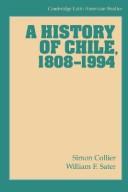
The standard English-language survey, written with William Sater, from independence to the early transition. Dry, comprehensive and the necessary spine — read it before anything on Allende, because most books on 1970-73 assume all of it.
The Popular Unity Years
IntermediateUnderstand the Allende government on its own terms — what it tried to do, who pushed it faster than it wanted to go, and how the economy and the political centre came apart. You should be able to explain the nationalisation of copper, the cordones industriales, and the argument over whether the government was overthrown or had already failed.
▸ Study plan for this stage
Pace: Three books, 911 pages. Victor Figueroa Clark's Salvador Allende is 176 pages, the shortest thing on this path, a sympathetic political biography and the most efficient route into what the Chilean road to socialism was actually supposed to be — read it first for the programme, and read it knowing it
- The Chilean road to socialism: a socialist transformation by strictly legal and constitutional means
- The nationalisation of copper and the unanimous congressional vote behind it
- The cordones industriales and worker seizures running ahead of government policy
- Inflation, shortages and the black market as political facts rather than merely economic ones
- The collapse of the political centre and the Christian Democrats' move toward the right
- American action — credit, covert funding, pressure — and its documented limits
- Harmer's regional frame: Brazil, Cuba and the wider hemispheric contest
- The October 1972 strike and the militarisation of the cabinet that followed
- What was the Chilean road to socialism supposed to be, in institutional terms?
- How did the copper nationalisation pass, and what did that unanimity conceal?
- In Winn's account, who was driving the pace of change, and how did the government respond?
- How much of the economic crisis was policy, how much was sabotage, and how would you tell?
- What does Harmer's evidence add that a United-States-centred account misses?
- Was the government overthrown or had it already failed? State what evidence would settle it.
- Take Winn's mill and write the sequence of events there beside the government's official policy timetable. The gap between the two columns is his thesis.
- Chart inflation, real wages and shortages across the Popular Unity years from Harmer and Collier, and mark the political events on the same axis.
- List every actor Harmer shows acting against the Allende government and, for each, note the archive she draws on.
- Write the strongest one-page case that the government collapsed, then the strongest case that it was destroyed. Do not decide yet.
Next up: You have the government's own account, the pressure from below and the regional context; the next stage brings the documents and the seventeen years that followed.

A short, sympathetic political biography and the most efficient way to understand what the Chilean road to socialism was actually supposed to be. Read it first in this stage for the programme, then test it against the two books that follow.
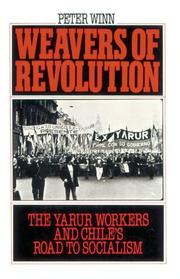
The Popular Unity period seen from a single textile mill, whose workers seized their factory and forced nationalisation ahead of the government's own timetable. The classic demonstration that the revolution from below and the revolution from above were not the same thing — and often in conflict.

The international dimension reconstructed from Chilean, Cuban, Brazilian and US archives. Harmer's argument that this was a regional cold war rather than simply a US operation is the most important recent revision here.
The Coup and the Dictatorship
IntermediateTake up 11 September 1973 and the seventeen years after it. You should be able to describe the DINA and Caravan of Death, the scale of the disappearances, what the declassified US record establishes and what it does not, and how the Chicago-School economic restructuring was carried out under conditions no democracy would have permitted.
▸ Study plan for this stage
Pace: Four books. Pilar Aguilera and Ariel Dorfman's Chile, the other September 11 has no recorded page count in our catalogue — it is a short anthology of essays, testimony and poetry gathered around the coup itself, read in a sitting, and it is the right way into the day before any analytical account. P
- 11 September 1973: the sequence of the day and the death of Allende
- The DINA, its structure, and its position outside the ordinary military chain
- The Caravan of Death and the pattern of early executions
- The scale and method of disappearance, and why the bodies matter to the legal record
- What the declassified American record establishes, and the difference between foreknowledge, encouragement and direction
- The Chicago School restructuring — privatisation, deregulation, pensions — carried out under conditions no democracy would have allowed
- The Catholic Church's Vicaría de la Solidaridad and the documentation it preserved
- The 1980 constitution and the institutional architecture designed to outlast the regime
- Describe the coup as a sequence of events on the day, distinguishing what was planned from what was improvised.
- What was the DINA, and to whom did it answer?
- What do the declassified documents actually show about American involvement, and what do they leave open?
- How was the economic restructuring possible, and what did it require politically?
- What did the church document, and why did it survive when other records did not?
- What did the 1980 constitution entrench, and for whose benefit?
- Read ten documents from The Pinochet File in full before reading Kornbluh's commentary on them, and write your own summary of what each establishes. Then compare.
- Build a timeline of the repression from Ensalaco — institutions created, phases of violence, documentation attempts — with the economic reforms on a parallel line.
- From Constable, list the ways ordinary life changed under the dictatorship for people who were not targeted. That is the part the document collections cannot show.
- Take the Caravan of Death and follow it through Ensalaco and Kornbluh, noting what each type of source contributes.
- Return to the two one-page cases you wrote in the last stage and revise them with the documentary evidence.
Next up: The facts of the dictatorship are now on the table; the last stage is about what a country does with them afterwards, which turns out to be a longer story than the regime itself.
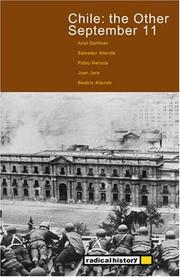
A short anthology of essays, testimony and poetry edited by Pilar Aguilera and Dorfman, gathered around the coup itself. The right way into the day before the analytical accounts — brief and read in a sitting.

The best portrait of Chile under Pinochet, written with Arturo Valenzuela by journalists who lived there — the fear, the economics, the church, the opposition. The single most useful book on what the dictatorship was like to live under.
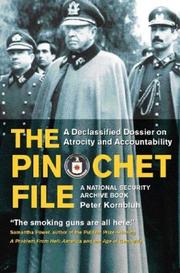
The declassified US documents on Nixon, Kissinger, the CIA and Chile, assembled with commentary by the National Security Archive analyst who fought for their release. Read the documents themselves and form your own view of how much they prove.

The apparatus of repression and the successive attempts to document it, from the Rettig report onward. Our catalogue credits a spurious second author on this record; the book is Ensalaco's.
Memory, Justice and the Transition
IntermediateFollow the argument about how Chile has and has not reckoned with the dictatorship. You should be able to explain the terms of the negotiated transition, the effect of Pinochet's 1998 London arrest, what the Rettig and Valech commissions each established, and why memory of the period remains contested rather than settled.
▸ Study plan for this stage
Pace: Five books, 2,112 pages, and the bulk of it is one historian's trilogy that has to be read in order. Steve J. Stern's Remembering Pinochet's Chile is 280 pages and is volume one, laying out the competing frameworks through which Chileans understand 1973 — salvation, rupture, persecution, the closed
- The terms of the negotiated transition and what the outgoing regime kept
- Pinochet as senator-for-life, the appointed senators, and the binomial electoral system
- Stern's memory frameworks — salvation, rupture, persecution, the closed box — and who holds each
- The 1988 plebiscite and the campaign that produced it
- The Rettig commission on deaths and disappearances, and the Valech commission on torture: different mandates, different findings
- Pinochet's 1998 London arrest and its effect on Chilean legal proceedings
- Operation Condor as a regional system, and the Letelier assassination on American soil
- Why memory of the period remains contested rather than settled, and what settlement would even mean
- What did the transition concede, and what did the opposition gain in exchange?
- Name Stern's memory frameworks and identify which Chileans hold each, and why.
- What did the Rettig commission establish, and what did the Valech commission add that Rettig could not?
- What did the London arrest change inside Chile, given that Pinochet was never tried there?
- How does Operation Condor change the way Chile's repression should be described?
- Was the negotiated transition prudence or capitulation? Answer from Stern's third volume rather than from instinct, then say where Muñoz, who lived in the country it produced, adds something a historian could not and where his being a participant is a limit.
- As you read Stern's first volume, assign the memory framework to each Chilean voice he quotes. Keep the tally; by volume three you will have a map of the country's divisions.
- Compare the Rettig and Valech mandates side by side — who was counted, who was not, and what each commission was forbidden to do.
- Trace one Condor case from Dinges across borders and note which state did what at each step.
- List what remained unchanged in Chilean law and the economy after the transition, and mark which items have since been altered.
- Write a final page answering the four disputes named at the start of this path — American involvement, whether Allende's government fell or was pushed, whether the economic model was worth its cost, and whether the transition was prudence or capitulation — citing a book for each.
Next up: This closes the path: you can state each of Chile's live arguments about its own recent past, say what evidence bears on it, and explain why none of them has been settled by the passage of time.

The first volume of Stern's trilogy on memory, laying out the competing frameworks through which Chileans understand 1973 — salvation, rupture, persecution, the closed box. Read the three in order; they are the most sustained work on this question anywhere in Latin America.

Volume two, on the struggle over public memory during the dictatorship itself, from the coup to the 1988 plebiscite. It shows the memory contest as an active political fight rather than an aftermath.

Volume three, covering the transition years to 2006 — the truth commissions, the London arrest, the slow legal erosion of impunity. The best account of what a negotiated transition can and cannot deliver.
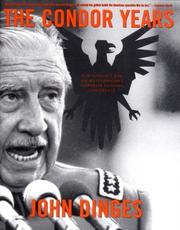
Operation Condor, the cross-border assassination network the Southern Cone dictatorships ran together, including the Letelier killing in Washington. It places Chile's repression in the regional system it belonged to.
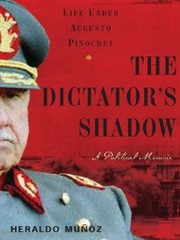
A memoir-history by a Chilean socialist who was a young activist in 1973 and later became foreign minister. Personal, judicious and the right book to close on, because it is written by someone who had to live in the country the transition produced.