Best Books on Superconductivity, in Reading Order
Superconductivity has the steepest prerequisite curve of any topic in condensed matter, because the phenomenon is visible to anyone and the theory is not: BCS requires second quantisation and a working command of many-body methods, and no amount of good writing gets around that. This path is built so you can stop honestly at any of three levels. The first stage is history and popular physics, readable by anyone. The second and third get you to a graduate-level understanding of what superconductors do, assuming undergraduate quantum mechanics and statistical mechanics. The fourth and fifth are the real theory and its applications, and they assume solid state physics and quantum field theory. A further warning: several standard references here are decades old in our records and have been revised since.
The story, and the phenomena
IntermediateKnow what a superconductor does — zero resistance, the Meissner effect, critical fields and temperatures — and how a century of experiment repeatedly outran the theory.
▸ Study plan for this stage
Pace: Six to eight weeks for 965 pages, and this stage requires no mathematics — it is also the first of three places where stopping is an honest outcome rather than a failure. Matricon and Waysand's The cold wars is 271 pages of narrative history from Kamerlingh Onnes's liquid helium to the cuprates, wri
- Zero resistance, and the experimental difficulty of establishing that it is exactly zero
- The Meissner effect, and why perfect diamagnetism is a stronger statement than perfect conductivity
- Critical temperature, critical field and critical current as three limits of the same state
- Type I versus type II behaviour, and the flux lattice
- Flux quantisation and the Josephson effect as the observable signatures of macroscopic quantum coherence
- Cooper pairing as the qualitative idea, before any formalism
- The high-temperature cuprates, and why their discovery was so unexpected
- The recurring pattern that experiment outran theory for most of the field's history
- Why does a perfect conductor not exhibit the Meissner effect, and what experiment distinguishes the two?
- What is the flux quantum, and what does its value tell you about the charge of the carriers?
- What distinguishes a type II superconductor from a type I, and why does type II carry useful currents in high fields?
- Why was the discovery of the cuprates so surprising to theorists, and which expectation did it violate?
- What does Hazen's account show about how the high-temperature race was actually conducted, and how does that differ from the published record?
- How much of the subject can you honestly say you understand after Ford and Saunders, and what specifically is missing?
- Build a timeline from Matricon and Waysand with experiments on one line and theories on another, and count how often the experiment came first
- Work out the flux quantum from the value of the fundamental constants and confirm that the carrier charge is twice the electron charge
- Read Blundell and Ford and Saunders on the Meissner effect and write out the argument for why it is not implied by zero resistance
- Compare Hazen's insider chronology of the cuprate race with the dates in Matricon and Waysand, and note where the participant and the historian differ
- Write a page on what you now understand and what you would need mathematics for — and decide honestly whether to continue
Next up: Everything from here is a calculation, and the next stage is the electronic structure background that every superconductivity text takes for granted and never supplies.
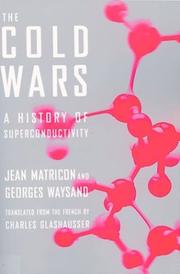
The narrative opener: Matricon and Waysand's history from Kamerlingh Onnes's liquid helium to the cuprates, written by physicists who were in the field. The right first book because superconductivity is a subject where knowing the order of discovery genuinely helps — almost every theory was proposed to explain something already measured.
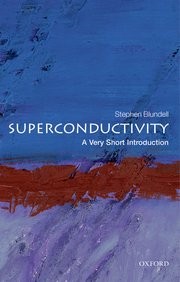
The best hundred pages on the subject at any level, by the author of the standard magnetism text. Blundell gets the physics of pairing and flux quantisation across without the formalism. Note that our catalogue displays it under the bare title Superconductivity, and that the record resolves only without the author's middle initial.
A participant's account of the 1986-87 high-temperature race, written from the inside of the group that found the 90-kelvin yttrium compound. Included because it captures something no textbook does: what a field looks like during the few months when nobody knows the rules.
Ford and Saunders bridge from the popular accounts to the physics — a real but undergraduate-level treatment of the phenomena, materials and applications. Read it as the last book before the mathematics starts, or as the stopping point if you would rather not go further.
The solid state physics assumed
BeginnerCommand the electronic structure background every superconductivity text takes for granted: free electron and band theory, the Fermi surface, phonons, and electron-phonon coupling.
▸ Study plan for this stage
Pace: Six months to a year for 1,473 pages, and this is the cliff. Undergraduate quantum mechanics and statistical mechanics are non-negotiable from here, and skipping this stage does not fail here — it fails in stage four, where Schrieffer opens with second quantisation over a Fermi sea and assumes phono
- The free electron gas, the Fermi surface, and the density of states at the Fermi level
- Bloch's theorem, band structure, and the distinction between metals, semiconductors and insulators
- Phonons: lattice dynamics, dispersion relations, and the Debye model
- Electron-phonon coupling, and why it is the interaction that matters here
- Screening, the Thomas-Fermi and Lindhard treatments, and the retardation that lets an attraction survive the Coulomb repulsion
- Second quantisation as a formalism for many identical particles
- The Sommerfeld expansion and the electronic contribution to the specific heat
- Fermi liquid theory as the description of a normal metal that superconductivity departs from
- Why does only a narrow shell of states around the Fermi surface participate in most low-temperature phenomena?
- What is a phonon, and how does the Debye model account for the low-temperature specific heat?
- How can an electron-phonon interaction produce a net attraction between two electrons despite the Coulomb repulsion, and what role does retardation play?
- What does Bloch's theorem let you do, and what does it not tell you about the band energies?
- What is the isotope effect, and why is it evidence for phonon involvement?
- What does Fermi liquid theory assert about a normal metal, and which of its assumptions a superconductor violates?
- Compute the Fermi energy, Fermi velocity and density of states for a real metal from its electron density, and compare with tabulated values
- Derive the Debye specific heat and confirm the low-temperature cubic dependence, then separate the electronic linear term as an experimentalist would
- Work Kittel's problems on the free electron gas until the standard results are automatic, then redo two of them with Ashcroft and Mermin's fuller treatment
- Follow the screening calculation in Ashcroft and Mermin and identify precisely where the frequency dependence enters
- Read Kittel's superconductivity chapter now, note what it asserts without proof, and keep the list to check against the next two stages
Next up: You now have the normal metal; the next stage describes what happens when it stops being one, at a level that stops short of the microscopic derivation.
The standard undergraduate route in, and the gentler of the two: crystal structure, phonons, band theory, and a chapter on superconductivity that is a good preview of stage three. Our record is a very early edition of a book now in its eighth — buy current.
Ashcroft and Mermin, the reference every condensed matter physicist owns, and the place to go for a derivation Kittel asserts. Harder and better. Our record credits only Ashcroft; David Mermin is the co-author, and the book has been essentially unchanged since 1976, so the age of the record is not a problem here.
The readable graduate introduction
BeginnerUnderstand pairing, the energy gap, coherence length and penetration depth, type I versus type II behaviour, vortices and the Josephson effect — at a level sufficient to read a research paper's introduction.
▸ Study plan for this stage
Pace: Four to six months for 1,112 pages, and this is the second honest stopping point on the path — a reader who completes this stage can read the introduction of a research paper and understand what is being claimed, without ever having derived the gap equation. Annett's Superconductivity, Superfluids,
- The order parameter as a macroscopic wavefunction, and what makes the coherence macroscopic
- The energy gap, and the experiments that measure it — tunnelling, specific heat, infrared absorption
- Coherence length and penetration depth, and the ratio that determines type I versus type II
- London equations and the phenomenological account of the Meissner effect
- Ginzburg-Landau theory as a free energy expansion, and the two characteristic lengths it produces
- Vortices, the Abrikosov lattice, flux pinning and flux flow resistance
- The Josephson effects, both direct and alternating, and the SQUID as their application
- The analogy across superfluid helium, condensates and superconductors, and where it breaks
- What is the order parameter physically, and in what sense is its phase observable?
- Derive the two characteristic lengths from the Ginzburg-Landau free energy and state what their ratio determines
- Why does a type II superconductor admit flux in quantised vortices rather than uniformly?
- Why does an unpinned vortex lattice produce resistance, and what does pinning do about it?
- State both Josephson effects precisely, and explain how a SQUID converts them into a magnetometer
- Which features of superfluid helium carry over to a superconductor and which do not, and what makes the difference?
- Derive the London penetration depth from the London equations and compute it for a real material from its carrier density
- Work the Ginzburg-Landau derivation of the coherence length and the penetration depth from the free energy, following Annett, then check your result against Tilley and Tilley's version
- Compute the ratio determining type I or type II for three materials from tabulated data in Poole and colleagues, and check your classification against the literature
- Sketch the magnetisation curve for a type I and a type II superconductor and mark the critical fields on each
- Work out the alternating Josephson frequency for a given voltage and confirm it is the standard used to define the volt
- Read the introduction of one recent research paper on a superconductor and mark every term you can now define — that count is the test of whether this stopping point is enough for you
Next up: Ginzburg-Landau is a phenomenology with the microscopic origin left out; the next stage supplies it, and requires second quantisation to do so.
The best entry to the theory: Annett treats superconductivity as one instance of macroscopic quantum coherence alongside superfluid helium and Bose-Einstein condensates, which makes the order parameter genuinely intuitive. Short, modern, and the book to start the technical half with.

Tilley and Tilley's classic pairing of the same two phenomena, and stronger than Annett on the phenomenological Ginzburg-Landau theory and on flux motion. Read the two together; where they overlap they explain each other. The record is an early edition of a book later revised twice.

Poole, Farach, Creswick and Prozorov's broad survey — the widest coverage of materials, measurements and phenomenology of any book here, at the cost of theoretical depth. Use it as the encyclopaedia beside Annett's course. It shares a bare display title with Blundell's very different short introduction above.
BCS, and the field's standard references
BeginnerFollow the microscopic theory: the Cooper instability, the BCS ground state and gap equation, and the Ginzburg-Landau and Abrikosov description of the mixed state.
▸ Study plan for this stage
Pace: Eight months to a year for 1,078 pages, and the page count badly understates the work — these are three of the densest books in condensed matter physics and they assume second quantisation, solid state physics from stage two, and comfort with quantum field theoretic language. Schrieffer's Theory of
- The Cooper problem, and why an arbitrarily weak attraction destabilises the Fermi sea
- The BCS variational ground state and its coherence factors
- The gap equation, its self-consistent solution, and the temperature dependence of the gap
- The BCS predictions that made the theory: the gap-to-critical-temperature ratio, the specific heat jump, the isotope effect
- Bogoliubov quasiparticles and the Bogoliubov-de Gennes equations in real space
- The proximity effect and Andreev reflection at a normal-superconductor boundary
- Ginzburg-Landau derived as a limit of the microscopic theory rather than postulated
- Abrikosov's vortex solution and the mixed state at the microscopic level
- Set up the Cooper problem and show why any attraction, however weak, produces a bound state — where does the density of states at the Fermi surface enter?
- Derive the gap equation from the BCS ground state and identify every approximation made along the way
- What is the BCS ratio of the gap to the critical temperature, and which materials violate it and why?
- What do the coherence factors do to the response functions, and how did they explain the nuclear relaxation rate peak?
- What is Andreev reflection, and how does it carry a current across a normal-superconductor interface?
- How is Ginzburg-Landau theory recovered from BCS, and in what temperature range is that derivation valid?
- Solve the Cooper problem yourself before reading Schrieffer's solution, and identify what makes the two-particle result different from a single-particle one
- Derive the BCS gap equation and solve it numerically for the temperature dependence of the gap, then compare with tunnelling data for a conventional superconductor
- Compute the specific heat jump at the transition from BCS and compare with measured values for two elemental superconductors
- Set up the Bogoliubov-de Gennes equations for a normal-superconductor interface following De Gennes and solve for the proximity length
- Derive the Ginzburg-Landau equations from the microscopic theory as Tinkham does, and identify which parameters are now determined rather than fitted
- Take the list you made of what Kittel asserted without proof in stage two, and tick off every item these three books have now derived
Next up: BCS explains the conventional superconductors and not the cuprates; the last stage is the formalism the modern literature uses to attack that problem, and the engineering the whole subject pays for itself with.
By the S of BCS, and still the clearest statement of the microscopic argument from someone who made it — the variational ground state, the gap equation, and the field-theoretic machinery. Assumes second quantisation. In print as an Advanced Book Classic; the physics has not dated.

The complementary classic, and the best treatment of the Bogoliubov-de Gennes equations, boundary problems and the proximity effect. De Gennes thinks in real space where Schrieffer thinks in momentum space, and having both is what makes vortex and interface problems tractable.
The standard reference of the field, and the one book here to own outright: phenomenology, BCS, Ginzburg-Landau, vortices, Josephson junctions and fluctuations, all at working depth. Read it last of the three, as consolidation. Our record is the 1975 first edition — the second edition of 1996 adds the high-temperature materials and is the one universally cited.
Many-body theory and applications
BeginnerAcquire the formalism the modern literature is written in, and connect the theory to the magnets, SQUIDs and qubits that superconductivity is actually used for.
▸ Study plan for this stage
Pace: A year or more, and this is a research-level stage rather than a course — take one direction rather than both. We hold no page count for Coleman's Introduction to Many-Body Physics, which is the modern graduate text on the machinery — Green functions, path integrals, broken symmetry — with supercond
- Green functions and the propagator formalism, and the diagrammatic expansion built on them
- The Nambu formalism and superconductivity as a broken symmetry problem
- Eliashberg theory as the strong-coupling extension of BCS
- Path integral methods and the effective action for the order parameter
- Unconventional pairing symmetry, and the experiments that determine it
- Superconducting wire and magnet design: critical current, flux pinning, quench protection
- SQUIDs and superconducting detectors as measurement instruments
- Superconducting qubits, Josephson junction circuits, and coherence times as the design constraint
- What does a Green function encode, and why is the diagrammatic expansion the natural language for an interacting system?
- How does the Nambu formalism make superconductivity look like a symmetry-breaking problem, and what does that buy you?
- What does Eliashberg theory add over BCS, and for which materials is the difference measurable?
- How is pairing symmetry determined experimentally, and what makes phase-sensitive experiments decisive?
- What limits the critical current of a practical superconducting wire, and why is it pinning rather than the gap?
- What limits the coherence time of a superconducting qubit, and which of those limits is fundamental to the material rather than to the fabrication?
- Compute a simple Green function for free fermions from Coleman's definitions and confirm the pole structure gives the excitation spectrum
- Write the BCS problem in Nambu notation and verify you recover the gap equation you derived in the previous stage
- Take one phase-sensitive experiment establishing d-wave pairing in a cuprate, and reconstruct why the result cannot be explained by an s-wave order parameter
- Design a superconducting solenoid to a specified field using Seidel's chapters: choose the conductor, compute the critical current margin, and specify the quench protection
- Work through the circuit quantisation of a Josephson junction from Seidel's qubit chapters and identify where the anharmonicity that makes a qubit possible comes from
- Read a current research paper on unconventional superconductivity and list which formalism from Coleman each section is using
Next up: This is the end of the path: from here there is no next book, only the journal literature — the cuprate and iron-based pairing problem on the theory side, and the magnet, detector and qubit engineering on the applied side.

The modern graduate text on the machinery — Green functions, path integrals, broken symmetry — with superconductivity treated as a central example rather than an appendix. The right book if you intend to read current theory papers on unconventional and cuprate superconductivity.

The closing volume, and a deliberate change of register: a multi-author handbook on wires and magnets, SQUIDs and detectors, RF cavities and superconducting qubits. Where the theory of the previous stages meets the engineering that pays for it.
Discussion
Keep reading
Paths that share books, cover the same subject, or open a related topic.