Hunter x Hunter Reading Order: Where to Start and What Order to Read It In
Hunter x Hunter has no reading-order problem — publication order is the only order — but it does have a supply problem, and it is worth knowing about before you start. Yoshihiro Togashi has taken repeated multi-year hiatuses since 2006, the series is still unfinished, and the English volumes are catalogued unevenly, so this path runs from the Hunter Exam through the Zoldyck estate and Heavens Arena to the Phantom Troupe in York New City, and then stops where the catalogue does. That is roughly the first third of what exists, and it is also the stretch most readers agree is the cleanest introduction.
The Hunter Exam
BeginnerMeet Gon, Killua, Kurapika and Leorio, and get the series' central trick — that the tournament arc is a cover for a story about what each of these boys actually wants.
▸ Study plan for this stage
Pace: About a week. Four volumes, 184 + 192 + 192 + 192 pages, and manga at this pace is roughly an hour a volume — but read volume 3's Trick Tower slowly, because the puzzle logic there is the template for everything Togashi does later. Publication order is the only order this series has; there is nothin
- The four leads and what each of them actually wants: Gon's absent father, Killua's family, Kurapika's revenge, Leorio's money
- The exam as structure — a tournament arc used as a delivery mechanism for character rather than escalation
- Togashi's rule-based conflict design: puzzles with stated constraints, solved by reading people
- Hisoka as a tonal marker — the moment he appears, the register of the series is fixed
- Information asymmetry as the recurring source of tension, well before any power system exists
- The cost principle: characters win by accepting a real, specific loss, not by trying harder
- Which of the exam's phases are decided by physical strength, and which by something else? Keep a tally as you go.
- What does each of the four leads say they want, and where does the text suggest they want something different?
- What does Hisoka's behaviour in volume 2 tell you about the kind of story this is going to be?
- How does the Trick Tower sequence in volume 3 constrain the characters, and how is each constraint eventually used?
- By the end of volume 4, what has the series established about how conflicts get resolved in it?
- Keep a running tally across the four volumes of contests won by strength versus won by information, deduction or negotiation; the ratio is the series' whole argument.
- For each phase of the exam, write down the stated rules before reading the resolution, and try to solve it yourself — Togashi plays fair.
- Track Killua's panel time across volumes 1–4 and note the point at which the art starts giving him reaction shots he has not earned by dialogue.
- Reread the first chapter of volume 1 after finishing volume 4 and list what it set up that you did not notice the first time.
Next up: The exam establishes how the series thinks; the next stage gives it a formal power system and its emotional centre.

Volume 1. Gon leaves Whale Island to sit the Hunter Exam and find the father who abandoned him. Start here with no preamble; the first chapter does more setup work than any summary can.

Volume 2. The exam proper, and the introduction of Hisoka — the character who tells you what kind of series this is going to be. Read straight on.

Volume 3. Trick Tower and the first extended demonstration of Togashi's real interest: puzzles with rules, solved by reading other people rather than by fighting harder.

Volume 4 closes the exam. Note how little of it was decided by strength — that is the argument the whole series goes on to make.
The Zoldycks and Heavens Arena
IntermediateFollow the shift from exam to character study, and meet Nen — the power system that turns the series from a good shonen into a famously well-engineered one.
▸ Study plan for this stage
Pace: About a week, three volumes: 192, 202 and 192 pages. Volume 6 rewards genuinely slow reading — Nen is introduced there as a set of rules, and those rules govern every fight for the next two hundred chapters, so read the exposition pages properly rather than skimming to the next fight. Note that volu
- The Zoldyck estate as character exposition disguised as an arc — what the family reveals about Killua
- Nen's four principles — Ten, Zetsu, Ren, Hatsu — and what each physically does
- The six Nen types and the aptitude test, and why a type is a constraint rather than a stat
- Hatsu as personal expression: an ability tells you about its user, which is why the system doubles as characterisation
- Heavens Arena as a controlled environment for teaching the reader the rules alongside Gon
- Escalation with a ceiling — Togashi bounds power so that cleverness stays decisive
- What do the Zoldyck volumes establish about Killua's relationship to his family that his behaviour in the exam had only hinted at?
- Define Ten, Zetsu, Ren and Hatsu in one sentence each without looking them up.
- How does a character's Nen type relate to their personality as the manga presents it, and where is the fit loosest?
- Why does Wing teach Nen in the order he does, and what would go wrong in a different order?
- What does the Hisoka rematch demonstrate that the first encounter could not?
- Write out the Nen rules as a one-page reference sheet from volume 6 alone, then check every subsequent fight against it and note any apparent violation.
- Take three characters introduced by this point and predict their Nen type from personality before the manga states it; record your hit rate.
- Chart Gon's and Killua's fights in Heavens Arena side by side and describe, in one sentence each, how differently the two of them solve a problem.
- Reread the Zoldyck arc immediately after finishing volume 7 and mark what Killua's Nen aptitude retroactively explains about his behaviour on the estate.
Next up: With the rules in place, the series changes genre — the next stage is where the consequences of those rules start costing characters permanently.

Volume 5. The Zoldyck family estate, and the short arc that explains Killua and gives the series its emotional centre. The point at which most readers stop being able to put it down.
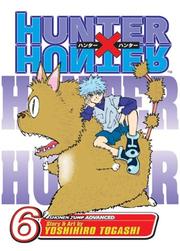
Volume 6. Heavens Arena begins and Nen is formally introduced. This volume rewards slow reading: the rules laid out here govern every fight in the next two hundred chapters.

Volume 7, and the one volume in this run that only resolves under the comma-and-capital form rather than the numbered form used for the others — a cataloguing quirk, not a different book. Nen training and the Hisoka rematch.
York New City
IntermediateWatch the series change genre — from tournament shonen to a heist-and-revenge thriller with a body count — and meet Kurapika's real plot.
▸ Study plan for this stage
Pace: Four or five days, two volumes at 192 pages each. This is a shift from tournament shonen to a heist-and-revenge thriller with a body count, and it moves faster than anything before it; read the two volumes together rather than a week apart. Volume 9 is catalogued with the subtitle 'Shadow Beasts'.
- Nen conditions and vows: strength bought with a permanent, self-imposed restriction — Kurapika's chains are the clearest case in the series
- The revenge plot that has been running under the surface since volume 1 finally becoming the main plot
- Genre shift as a deliberate technique — the same characters and rules producing a completely different kind of story
- The Phantom Troupe as an overwhelming threat introduced before it is explained
- Protagonists who are simply outclassed, and what the narrative does when winning is not available
- The auction and the information economy — value, secrecy and leverage replacing combat as the currency
- State the exact conditions Kurapika places on his own Nen. What does each one buy, and what does it cost him permanently?
- How does the York New arc change what a fight means in this series?
- Why does Togashi introduce the Troupe as a force before giving them individual personalities?
- Which of the four leads has the least agency in these two volumes, and what does the story do with that?
- What has the series given up by shifting genre here, and what has it gained?
- Write out Kurapika's vow as a formal contract — conditions, benefits, penalties — and then check every one of his subsequent fights against those terms.
- Track how many pages of volumes 8 and 9 contain no combat at all; compare the proportion to volumes 1–4 and describe what replaced it.
- List each Troupe member as they appear with only what the text has told you about them so far; you will want that list for the next stage.
- Reread Kurapika's introduction in volume 1 against volume 8 and note how much of the York New plot was already stated there.
Next up: The Troupe is a threat in these two volumes; in the next stage it becomes a group of people, which is the move that makes the arc work.

Volume 8. The Nen conditions Kurapika sets on himself are the best single demonstration of what Togashi does with a power system: the strength is bought with a genuine, permanent cost.

Volume 9. The auction, the Phantom Troupe, and the first sustained stretch where the protagonists are simply outclassed. Catalogued with the subtitle Shadow Beasts.
The Phantom Troupe
IntermediateReach the arc most readers name as the series' peak, and understand why the path stops here rather than continuing.
▸ Study plan for this stage
Pace: Three or four days for two volumes; our catalogue records for volumes 10 and 11 do not carry a page count, but they are standard Viz volumes and read at the same pace as the rest. Volume 10 is catalogued with the subtitle 'Fakes, Swindles, and the Old Switcheroo' and volume 11 as 'Next Stop: Meteor
- The Troupe humanised — the shift from antagonist-as-threat to antagonist-as-group, and why that makes the arc land
- Meteor City as backstory that reframes the Troupe's ethics rather than excusing them
- Chrollo, Uvogin, Pakunoda and the individual abilities as characterisation rather than power inflation
- Divided loyalty inside a villain group as a plot engine
- Nen abilities that turn on information — memory, promises, and conditions imposed on others
- The unfinished-series problem: Togashi's repeated multi-year hiatuses since 2006, and what that means for committing to this story
- At what specific point does the manga stop treating the Troupe as a single entity, and what technique does it use to do it?
- What does Meteor City explain about the Troupe, and what does it fail to excuse?
- How does Pakunoda's ability create an obligation that combat could not?
- Which Troupe member does the arc make you least willing to see killed, and how did Togashi engineer that?
- What has this path covered, and what remains — Greed Island, the Chimera Ant arc, and everything after?
- Take the Troupe list you built in the previous stage and add, for each member, the first panel that gave them an interior life; you are charting the exact mechanics of the humanisation.
- Reread Uvogin's fight in volume 9 after finishing volume 11 and write down what changed about how it reads.
- Trace one piece of information through the arc — who knows it, when, and what each holder does with it — and see how much of the plot is an information-flow diagram.
- Write a paragraph on what the series has argued about strength across all eleven volumes, then continue in print or digital from volume 12 and check the claim against the Chimera Ant arc.
Next up: From volume 12 the series runs into Greed Island and then the Chimera Ant arc, which is the stretch most readers name as its peak — continue in print or digitally, since the English catalogue records this path draws on do not reliably cover them.

Volume 10, catalogued with the subtitle Fakes, Swindles, and the Old Switcheroo. The Troupe becomes a group of people rather than a threat, which is the move that makes the arc work.

Volume 11, catalogued as Next Stop: Meteor City. The path ends here for a practical reason worth stating plainly: from volume 12 onward the English-language records thin out badly and the volumes resolve mainly to Japanese editions, so we cannot list them reliably. Keep reading in print or digitally from volume 12 — Greed Island follows, then the Chimera Ant arc, which is the one people argue is among the best things the medium has produced.