How to learn History
This curriculum takes you from the big picture of human history all the way down to the craft, debates, and philosophy that professional historians wrestle with. Each stage builds on the last: first you develop a mental map of the whole human story, then you zoom into pivotal eras and forces, then you grapple with how and why history is written the way it is.
The Big Picture — A Map of Human History
BeginnerBuild a confident mental timeline of human civilization from prehistory to the modern era, and develop the vocabulary to talk about historical change.
▸ Study plan for this stage
Pace: 10–12 weeks total. Weeks 1–7: "The History of the Ancient World" (~25–30 pages/day, reading in chunks by civilization/region). Weeks 8–12: "Guns, Germs, and Steel" (~20–25 pages/day, pausing after each Part to review Diamond's argument before moving on).
- Chronological frameworks: how historians divide time into eras (prehistory, ancient, classical, medieval, modern) and why periodization is a tool, not a fact — anchored in Bauer's sweeping narrative from Sumer to Rome
- The rise of the first civilizations: how Mesopotamia, Egypt, India, and China independently developed writing, cities, and centralized governance as traced in Bauer's parallel regional chapters
- Cause and effect in history: understanding that events have multiple, layered causes rather than single explanations — practiced through Bauer's narrative of dynastic rises and collapses
- Geographic determinism vs. human agency: Diamond's central thesis that environmental factors (plant and animal domesticates, continental axes, disease) gave certain societies structural advantages — and how to hold this in tension with the individual stories in Bauer
- The Neolithic Revolution and its consequences: the shift from foraging to agriculture as the hinge event that made everything in both books possible
- Diffusion vs. independent invention: how ideas, technologies, and diseases spread across cultures, a key analytical lens Diamond applies throughout 'Guns, Germs, and Steel'
- Vocabulary of historical change: terms such as city-state, empire, hegemony, surplus, stratification, domestication, and epidemic — encountered organically in both books
- Reading history critically: recognizing an author's argument, evidence, and blind spots — Bauer as narrative historian vs. Diamond as interdisciplinary scientist
- After reading Bauer, can you sketch a rough timeline placing Sumer, Egypt, the Indus Valley, and early China in relation to one another — and explain what was happening in at least two of these regions simultaneously?
- What does Bauer's account reveal about why early empires collapsed, and can you name at least two recurring patterns across different civilizations?
- In your own words, what is Jared Diamond's central argument in 'Guns, Germs, and Steel,' and what three or four factors does he identify as the primary drivers of Eurasian dominance?
- How does Diamond use the Fertile Crescent's geography and its available domesticable plants and animals to explain why agriculture arose there first — and what does this mean for societies that lacked those advantages?
- Where do Bauer and Diamond complement each other, and where might they be in tension? (For example: does Diamond's structural argument leave room for the individual rulers and decisions Bauer describes?)
- What historical vocabulary from these two books can you now use confidently, and how would you explain the concept of 'surplus' to someone who has never studied history?
- Build a living timeline: Create a large visual timeline (paper, whiteboard, or a free tool like Canva or TimelineJS). As you read Bauer, add civilizations, key events, and dates. When you start Diamond, annotate the same timeline with his structural explanations — e.g., mark when and where the Neolithic Revolution occurred and draw arrows showing diffusion routes.
- Parallel civilization chart: After finishing Bauer's sections on Mesopotamia, Egypt, India, and China, fill in a four-column table with rows for: writing system, political structure, major collapse/turning point, and geographic advantage or constraint. This directly trains the comparative thinking Diamond demands.
- Argument mapping for Diamond: After each Part of 'Guns, Germs, and Steel,' write a 3–5 sentence summary of Diamond's sub-argument in that section. At the end of the book, assemble these into a one-page argument map showing how each piece supports his overall thesis.
- Vocabulary journal: Keep a running glossary of 30–40 terms encountered across both books (e.g., city-state, hegemony, epidemic, domestication, continental axis). For each term, write the definition in your own words and cite a specific example from the text.
- 'Steel-man the other side' reflection: Diamond's thesis has critics who argue it underweights human agency and culture. After finishing both books, write one page defending Diamond using Bauer's evidence, then write one page challenging Diamond using Bauer's evidence. This forces you to use both books actively.
- Teach-back exercise: Choose one civilization from Bauer (e.g., the Akkadian Empire) and explain its rise and fall first in Bauer's narrative terms, then through Diamond's analytical lens. Write or record a 5-minute explanation as if teaching a friend — the gap between what you can and can't explain clearly will reveal exactly what to review.
Next up: Having built a confident mental timeline and a toolkit of analytical vocabulary from Bauer's narrative sweep and Diamond's structural framework, the reader is now equipped to zoom in on specific periods or regions with both chronological confidence and a habit of asking "why" — the essential preparation for deeper thematic or era-specific study in the next stage.
An irresistibly readable sweep from the Stone Age to the 21st century that introduces core historical concepts — revolution, empire, religion, capitalism — without assuming prior knowledge. It gives you the skeleton on which everything else hangs.

After Harari's bird's-eye view, Bauer grounds you in the actual narrative of the earliest civilizations — Mesopotamia, Egypt, Greece, Rome, China, India — teaching you how to read primary-source-based history for the first time.
Introduces the crucial question of *why* history unfolded differently across continents, training you to think causally and analytically rather than just memorizing events.
Pivotal Eras — Depth Over Breadth
BeginnerDevelop a richer understanding of specific turning-point periods — the classical world, the early modern era, and the modern age — and practice reading more detailed historical narrative.
▸ Study plan for this stage
Pace: 10–12 weeks total, roughly 25–35 pages per day. Allocate ~3 weeks for "The Fate of Rome" (approx. 290 pages of main text), ~4 weeks for "The Silk Roads" (approx. 600 pages), and ~3–4 weeks for "The Age of Revolution" (approx. 360 pages). Read on weekdays; reserve weekends for review, note-taking, an
- Climate and disease as historical forces: Harper's argument in 'The Fate of Rome' that the Antonine Plague, the Plague of Cyprian, and climate cooling were decisive — not merely background — causes of Rome's decline.
- Systems fragility and collapse: How a highly integrated empire (Rome) becomes vulnerable precisely because of its interconnectedness — a lesson Harper makes concrete through trade networks, urban density, and military overextension.
- The Silk Roads as the true center of world history: Frankopan's reorientation away from a Europe-first narrative, showing that Central Asia, Persia, and the Islamic world were the engines of global exchange for most of recorded history.
- Trade, religion, and power as inseparable: Across 'The Silk Roads,' how the spread of Islam, Buddhism, and Christianity followed commercial routes, and how controlling trade arteries translated directly into political dominance.
- The dual revolution — industrial and political: Hobsbawm's core thesis in 'The Age of Revolution' that the French Revolution and the British Industrial Revolution together, between 1789 and 1848, remade the social, economic, and political fabric of the world.
- Class as a historical actor: Hobsbawm's Marxist-influenced framework — understanding how the rise of the bourgeoisie and the emergence of the working class were products of, and drivers of, revolutionary change.
- Periodization and turning points: All three books model how historians select a period and argue for its pivotal importance — practicing the skill of asking 'why does this era matter and to whom?'
- Causation at multiple scales: Distinguishing between long-run structural causes (climate, geography, economics) and short-run triggers (plague outbreaks, political revolutions, individual decisions) across all three books.
- According to Kyle Harper, what roles did the Antonine Plague and the Roman Climate Optimum play in Rome's rise and fall — and how does his argument challenge older, purely political explanations of Rome's decline?
- How does Peter Frankopan reframe the importance of the Silk Roads, and which specific regions or civilizations does he argue have been unfairly marginalized by traditional Western-centric histories?
- In 'The Silk Roads,' how did control of trade routes translate into religious and political power, and can you trace one concrete example of this dynamic across at least two centuries?
- What does Hobsbawm mean by the 'dual revolution,' and why does he treat the French Revolution and the British Industrial Revolution as a single, unified historical force rather than two separate events?
- How does Hobsbawm describe the social consequences of industrialization for ordinary people, and what new political ideologies and class identities emerged from those conditions by 1848?
- Across all three books, what patterns do you notice in how historians build an argument — what kinds of evidence (environmental, economic, political, cultural) do Harper, Frankopan, and Hobsbawm each rely on most heavily?
- Timeline wall: Create a single continuous timeline spanning 200 CE to 1848 CE. As you finish each book, add its key events, turning points, and causal factors in a different color. Look for overlaps — e.g., where do the Silk Roads connect to Rome's decline? Where do Frankopan's trade networks appear in Hobsbawm's industrial world?
- Cause-and-effect mapping: After finishing 'The Fate of Rome,' draw a simple diagram with 'Rome's Decline' at the center. Branch out with at least six causes Harper identifies, labeling each as environmental, biological, economic, or political. Repeat this exercise for the French Revolution using Hobsbawm.
- Reorientation exercise: After reading Frankopan's reframing, write one page from the perspective of a Sogdian merchant in 800 CE or a Persian scholar in 1000 CE describing their world. The goal is to practice seeing history from a non-European vantage point.
- Argument summary cards: For each book, write a single index card (max 150 words) answering: What is the author's central argument? What is their strongest piece of evidence? What might a critic object to? Compare the three cards side by side when finished.
- Comparative essay (500–700 words): Choose one theme — trade, disease, or political upheaval — and trace how it appears in all three books across different eras. This forces you to connect the books rather than treat them as isolated reads.
- Vocabulary and concept log: Keep a running glossary of unfamiliar terms (e.g., 'pandemic,' 'bourgeoisie,' 'entrepôt,' 'caliphate,' 'proletariat'). After each book, review the log and write one sentence showing how each term connects to the book's central argument.
Next up: By mastering how three expert historians construct arguments around pivotal eras — using environmental, economic, and social lenses — the reader is now equipped to tackle more thematically or analytically demanding historical works that require evaluating competing interpretations rather than following a single author's narrative.

A masterclass in how historians weave together political, environmental, and social threads; reading Rome's fall in depth shows you what rigorous historical argument looks like.

Recenters world history away from Europe and toward Central Asia and the Middle East, expanding your geographic imagination and showing how trade and exchange drive civilizational change.

A landmark work on the period 1789–1848 that introduces you to social and economic history alongside political history, bridging the early modern world to the one we live in.
Forces That Shape History — Themes and Systems
IntermediateMove beyond narrative to understand the deep structural forces — economics, disease, ideology, geography — that historians use to explain change over time.
▸ Study plan for this stage
Pace: 12–14 weeks total (~25–35 pages/day, 5 days/week): Weeks 1–5 for The Wealth of Nations (focus on Books I–III and selected sections of IV–V, ~900 pages abridged or full); Weeks 6–9 for Plagues and Peoples (~340 pages); Weeks 10–14 for The Origins of Totalitarianism (~530 pages). Reserve one buffer da
- Division of labor and the pin factory: how specialization drives productivity and economic complexity (Smith)
- The invisible hand and self-regulating markets: how decentralized decisions aggregate into systemic outcomes (Smith)
- Mercantilism vs. free trade: competing ideologies of economic power and their historical consequences (Smith)
- Epidemiological history: disease not as random tragedy but as a structural force shaped by population density, trade routes, and immunity gaps (McNeill)
- Macro-parasitism vs. micro-parasitism: McNeill's framework for understanding how both conquerors and pathogens extract surplus from host populations (McNeill)
- The Columbian Exchange as a disease event: how differential immunity reshaped demographic and political power across continents (McNeill)
- The origins of antisemitism and racism as modern ideological systems, distinct from pre-modern prejudice, that provided the building blocks for totalitarian movements (Arendt)
- Totalitarianism as a novel form of government: how it differs from tyranny or authoritarianism through its use of terror, ideology, and the destruction of the private self (Arendt)
- According to Smith, how does the division of labor simultaneously increase national wealth and create new forms of social dependency — and what does this tension reveal about capitalism as a historical force?
- McNeill argues that disease shaped the outcomes of conquest more decisively than military technology in many cases. Using examples from Plagues and Peoples, how does epidemiology function as a structural force in history?
- How does Arendt distinguish totalitarianism from ordinary despotism or authoritarianism, and why does she insist it is a genuinely new phenomenon of the 20th century?
- All three books deal with systems that operate largely beyond individual human intention. How do Smith's 'invisible hand,' McNeill's disease ecology, and Arendt's ideological terror each describe impersonal forces that nonetheless produce massive historical change?
- Arendt traces totalitarianism's roots through imperialism and the breakdown of the nation-state. How does her historical genealogy connect the economic themes raised by Smith to the political catastrophes she analyzes?
- After reading all three books, how would you construct a multi-causal explanation for a single major historical event (e.g., the fall of the Roman Empire, the colonization of the Americas, or the rise of Nazi Germany) using economic, epidemiological, and ideological lenses simultaneously?
- Structural force mapping: After finishing each book, draw a diagram showing the key structural force (economic, epidemiological, ideological) as a system — identify inputs, feedback loops, and historical outcomes. Compare all three diagrams at the end to find patterns.
- Counterfactual writing: Write a 1–2 page response to this prompt for each book — 'Remove this structural force from history. What changes?' (e.g., no market specialization, no Old World diseases in the Americas, no totalitarian ideology). This forces active engagement with causal weight.
- Annotated timeline: Build a single shared timeline across all three books, marking events each author would consider pivotal. Note where their explanations for the same event overlap or conflict (e.g., the Black Death appears in both McNeill and has economic echoes in Smith's analysis of labor scarcity).
- Debate preparation: Formulate the strongest possible argument that ONE of the three forces (economics, disease, ideology) is the most fundamental driver of historical change, then write the steelman rebuttal from the perspective of each of the other two books.
- Primary source pairing: For each book, find and read one short primary source it references or implies (e.g., a passage from Thucydides on the Plague of Athens for McNeill; a Nazi Party document or speech for Arendt; a mercantilist pamphlet for Smith). Write a paragraph on how the primary source either supports or complicates the author's argument.
- Synthesis essay: At the end of the stage, write a 3–5 page essay answering: 'Are the forces described by Smith, McNeill, and Arendt complementary, competing, or hierarchical explanations of historical change?' Use specific evidence from all three texts.
Next up: By mastering how economics, disease, and ideology operate as deep structural forces, the reader is now equipped to move from explanation to agency — examining how individuals, states, and social movements have consciously responded to, resisted, or harnessed these forces across specific historical periods.
Reading this foundational economic text in its historical context shows how ideas themselves become historical forces, and why economic history is inseparable from political history.

A pioneering work in environmental and epidemiological history that permanently changes how you see the role of disease in the rise and fall of civilizations.

A demanding but essential analysis of how 20th-century ideological catastrophes emerged from modern history — it teaches you to read history with philosophical and moral seriousness.
How History Is Made — Historiography and Method
ExpertUnderstand how historians construct arguments, what sources and evidence mean, how interpretations change over time, and how to read any historical work critically.
▸ Study plan for this stage
Pace: 2–3 weeks, ~20–25 pages/day — Carr's book is short (~150 pages) but dense with argument; plan for one chapter per sitting (6 chapters total), followed by a dedicated review/synthesis day after every two chapters.
- The historian-fact relationship: facts do not 'speak for themselves' — they are selected and interpreted by the historian, making history an active construction rather than passive recovery
- The dialogue between past and present: Carr's central metaphor that history is a continuous conversation between the historian (shaped by their present moment) and the past they study
- Causation and the hierarchy of causes: how historians assign significance to causes, distinguish between immediate triggers and deeper structural forces, and why causal selection is always an interpretive act
- The role of the individual vs. social forces: Carr's critique of 'great man' history and his argument for prioritising broader social, economic, and political processes
- Objectivity reconsidered: Carr's rejection of both naive objectivity (the 'scissors-and-paste' historian) and pure relativism — history as a progressive, if imperfect, pursuit of truth
- The historian's standpoint and bias: how a historian's nationality, class, era, and ideology inevitably shape their questions, source selection, and conclusions
- Progress in history: Carr's controversial argument that history has direction and that the historian's job includes evaluating the past against standards of human progress
- What counts as a historical source and how historians evaluate, corroborate, and interrogate evidence
- According to Carr, why is the statement 'history is the facts' fundamentally mistaken, and what does he propose instead?
- What does Carr mean by the 'dialogue between past and present,' and what are the implications of this metaphor for how we judge any historical work?
- How does Carr distinguish between a 'historical fact' and a mere 'fact about the past'? Give a concrete example of each.
- What is Carr's position on historical objectivity — does he think it is achievable, and on what grounds does he reject both naive positivism and pure relativism?
- How does Carr treat causation? Why does he argue that the search for a single 'decisive' cause is philosophically misguided?
- What does Carr mean when he says the historian must study both the history and the historian? How should this change the way you read any historical book?
- Historian audit: Choose any popular history book or documentary. Before engaging with its content, research the author's background (nationality, era, institutional affiliation, political leanings). Write a one-page 'standpoint profile' predicting what biases or emphases Carr would expect to find, then read/watch and check your predictions.
- Fact vs. interpretation log: While reading each chapter of Carr, keep a two-column notebook — left column for claims Carr presents as factual, right column for claims that are clearly interpretive. At the end, review: where is the line blurry? Write a short reflection on what this exercise reveals about Carr's own argument.
- Causal hierarchy exercise: Pick a major historical event you already know (e.g., World War I, the French Revolution). List at least eight causes, then rank them using Carr's framework — immediate vs. structural, individual vs. social. Write a paragraph defending your top-ranked cause and anticipating a counterargument.
- Dialogue with the text: After finishing the book, write a one-to-two page 'letter to Carr' from the perspective of a historian writing today. Where do his arguments hold up? Where does his Cold War context, his Marxist-leaning progressivism, or his gender/cultural blind spots show through? Use his own method against him.
- Source interrogation drill: Find a primary source (a newspaper editorial, a political speech, a photograph from any historical period). Write a structured analysis answering: Who created it? For what audience and purpose? What does it reveal, and what does it conceal? How would Carr classify it as historical evidence?
- Chapter précis challenge: After each of the six chapters, write a strict 100-word summary of Carr's core argument in that chapter — no padding. Then, in a separate sentence, write your single sharpest objection to it. Review all six précis together at the end to map the book's overall argumentative arc.
Next up: Carr equips the reader with a critical lens for interrogating how any historical argument is built, making them ready to apply that lens actively — moving from understanding historiographical theory in the abstract to encountering diverse schools of historical thought, primary source traditions, and period-specific methodologies in practice.
Written by one of the 20th century's greatest historians, this short classic explains what history is, how evidence works, and why the discipline matters — essential reading before tackling historiographical debates.
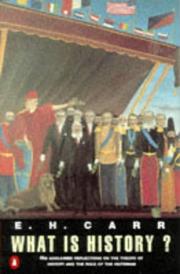
The single most-assigned text in history methodology courses worldwide; Carr forces you to question the relationship between the historian, the facts, and the present — completing your transformation from reader to critical thinker.
Discussion
Keep reading
Paths that share books, cover the same subject, or open a related topic.