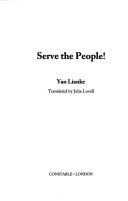
Start with Serve the People!. It runs to 144 pages and it is the compressed version of everything he does: a young orderly and a division commander's wife conduct an affair in which smashing Mao memorabilia becomes the erotic charge, and the whole apparatus of revolutionary piety is turned inside out over a single summer. It is funny, it is short, and it establishes the register — deadpan about the absurd, unsparing about the cost — that the longer books depend on.
The obvious alternative is Dream of Ding Village, which is the one most often recommended and the most immediately moving. It is also two hundred pages longer and considerably harder to sit with, and it works far better once you already know how he writes. Read it second.
Dream of Ding Village
This is the book about the blood-selling scandal in rural Henan, where villagers were encouraged to sell plasma through unsanitary collection stations in the 1990s and a whole generation contracted HIV. Yan worked as an assistant to an anthropologist studying the affected villages, and the novel is narrated by a dead child whose father ran the blood trade. It is the most conventionally realist thing in his bibliography and the most direct in its anger. It was withdrawn from sale in mainland China shortly after publication.
Mythorealism, and the two books that need it
Yan coined a term for his own method, usually translated as mythorealism: an approach that abandons surface plausibility because, in his account, the reality he is describing has already outrun what realism can represent. It sounds like a defensive slogan until you read the books, at which point it becomes a set of practical instructions for how to read them.
Lenin's kisses is the clearest case. A village of disabled people, historically left alone by the state, is recruited into a performing troupe to raise money for a county chief's plan to buy Lenin's embalmed corpse from Russia and install it as a tourist attraction. The novel has an unusual apparatus — long chapters of notes and local history interleaved with the narrative, which are not optional background but part of the book — and readers who skip them find the ending underpowered. Take them at the pace they are given.
The explosion chronicles pushes further: the history of a village that becomes a hamlet, a town, a city and a megalopolis within one generation, written in the form of an official local gazetteer, with the rate of growth treated as a physical force. It is the funniest of the later books and the most openly allegorical.
The four books
The four books is his most ambitious novel and the hardest. It is set in a re-education camp on the Yellow River during the Great Leap Forward and the famine that followed, its characters are named only by function — the Author, the Scholar, the Musician, the Child — and it is assembled from four separate manuscripts that contradict each other. Nobody should start here. Read it fourth or fifth, when the method is familiar, and it becomes the book that justifies all of it. It was shortlisted for the International Booker Prize in 2016.
The Day the Sun Died belongs alongside it as the other formally demanding one: a single night in which an entire town begins sleepwalking and acting out what it actually wants. It is claustrophobic by design and is the least good entry point of anything here.
The memoir
Three Brothers is the outlier and a useful cooling-off book: a straightforward account of his father and two uncles in rural Henan, of poverty and illness and the decision to leave. There is no formal experiment in it at all. It explains where the material comes from and it is the gentlest thing he has written.
A note on the bans
Several of these books are banned or were withdrawn in mainland China, and The four books was rejected by every mainland publisher he approached and appeared first in Hong Kong and Taiwan. That is a fact about their reception, not an argument about their quality, and it is worth resisting the temptation to read them as documents rather than novels. He continues to live and write in Beijing, has taught at Chinese universities, and won the Franz Kafka Prize in 2014.
Where to stop
Two books give you the writer: Serve the People! and Dream of Ding Village. Four give you the range: add Lenin's kisses and The four books. Beyond that you are reading him because you want all of it, which is a reasonable thing to want.
Follow the full ordered path here: Yan Lianke Reading Order: Where to Start with China's Most Banned Novelist.