Trial advocacy is a craft with a real literature, and nearly all of it is jurisdiction-bound. The objections, the rules of evidence and the shape of a closing differ between an American courtroom and an English one, and much of what reads like timeless technique is really local procedure. This list is built on United States practice, with one English book read alongside as deliberate contrast.
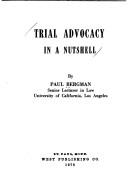
Start with Paul Bergman's Trial advocacy in a nutshell, the compact American overview of the whole sequence from pleadings to verdict — written to be read straight through rather than consulted. Our record is a 369-page early edition of a book revised many times; trial rules move, so buy the current one. Then Iain Morley's The Devil's Advocate, 271 pages written for barristers in England and Wales. Roughly half of it — nerves, preparation, the discipline of not saying too much — is jurisdiction-free. The procedural half is not. Read it for temperament, not rules.
The working manuals
Thomas Mauet's Trial techniques and trials is the standard United States practice text and the book most American advocacy courses are built around. One buying warning: the same work has appeared over the decades as Fundamentals of Trial Techniques and then as Trial Techniques, so it is easy to end up with two copies of one book. It tracks the Federal Rules of Evidence closely, which makes it the most edition-dependent title on this list.
Steven Lubet's Modern trial advocacy is the analytical counterpart — it treats every trial decision as a persuasion problem and reasons about why a technique works rather than only how it is executed. James McElhaney's McElhaney's trial notebook is short essays on individual problems collected from decades of a column for American trial lawyers: a hostile witness, a bad fact, an exhibit that will not come in. Read it in pieces once Mauet has given you a framework to hang them on. David Berg's The Trial Lawyer, 309 pages, is a practising litigator's account of how he prepares and tries a case, with transcripts — the fastest way to see the manuals' advice under real pressure.
Witnesses
Francis Wellman's The Art of Cross Examination is the 1903 classic, still in print, built from transcripts of New York trials, and the book every later writer on cross is answering. Our record is a 224-page later printing. Read it for the anatomy of a destructive question and remember the evidentiary rules around it are a century out of date. Michael Tigar's Examining Witnesses, 491 pages, is the corrective: the same craft on direct and cross under contemporary Federal Rules of Evidence, written by someone who tried the cases he describes. His companion volume, catalogued under the bare title Persuasion, covers the theory — story, ethos and how juries actually reason — and explains the purpose the technique is serving.
Framing the case, and the money
This stage is American plaintiff-side literature, and it is contested inside the profession, which is part of why it is worth reading. Rick Friedman and Patrick Malone's Rules of the road sets out a method for reducing a negligence case to a short list of rules the defendant broke, so the jury has something concrete to decide; it is the most influential single idea in modern American plaintiff practice.
David Ball and Don Keenan's Reptile is the one to read with your eyes open. Its safety-and-danger framing is widely taught and widely imitated, and it is also openly attacked by defence practitioners and some judges as an improper appeal to jurors' self-interest. That dispute is live and unresolved; treat the book as contested doctrine rather than settled technique. David Ball on damages 3 is the standard American text on asking a jury for a number and giving them a structure that makes it defensible — our record is the third edition, which is the current one. Damages practice is state-specific: the method is portable, the figures are not.
The words
Most litigation is written, and the brief usually reaches the judge before the advocate does. Making your case is Antonin Scalia and Bryan Garner on persuading judges, in short numbered rules covering brief and oral argument; our record's author field lists only Scalia. Garner's Legal writing in plain English, 159 exercise-driven pages, closes the list because it is the one thing here you can practise every day without a courtroom.
Books do not confer the right to appear in court, and none of this is legal advice. The staged version, with a plan for each stage, is at /paths/pt_ai_trial-advocacy-and-litigation.