Nobody knows how life began. That is not a rhetorical opening; it is the fact that determines how this subject should be read. There is no consensus theory, no experiment has produced a living system from non-living chemistry, and the leading researchers disagree with each other in print. Every popular book in this field is therefore advocating for a position, and the honest ones say so on the first page.
Which is why reading order matters more here than in a settled science. If your first book is a persuasive account of one hypothesis by its own best advocate, you will not know what it is arguing against. Take the definitional and historical books first, and everything after them reads as a contribution to an argument rather than as a report of findings.
What is being explained
Life's Edge by Carl Zimmer is the right first book, because it makes the definitional problem vivid rather than abstract: viruses, hibernating bats, slime moulds, tardigrades, and a series of cases where the boundary between living and not living refuses to hold. Zimmer is a reporter rather than a partisan, which is exactly what you want at the start.
What Is Life? by Paul Nurse comes at it from the other direction — a Nobel-winning cell biologist setting out the small number of ideas he thinks the whole of biology rests on. It is very short, and it gives you the vocabulary for everything that follows.
Where the field has been
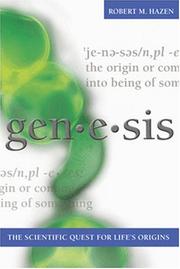
Genesis by Robert Hazen is the mineralogist's account, arguing for the role of mineral surfaces in concentrating and organising early chemistry, and it doubles as a good picture of how origins research is actually done — funding, rivalries, failed experiments. Genesis Quest by Michael Marshall is the historical survey: a century of hypotheses, from Oparin and Haldane through Miller-Urey to the RNA world, with the false starts left in. The two overlap in coverage. If you want one, take Marshall for the history of the field and Hazen for the laboratory view from inside it.
The competing hypotheses
Two families of explanation dominate, and they are not reconciled. One says replication came first — self-copying molecules, with metabolism assembled around them later. The other says metabolism came first — self-sustaining chemical cycles driven by an energy gradient, with genetics arriving afterwards. They imply different environments and different experiments.
The vital question by Nick Lane is the strongest statement of the metabolism-first case, locating the origin at alkaline hydrothermal vents where natural proton gradients could have powered the first chemistry. It is the most intellectually thrilling book in the path and it is unambiguously an argument for one hypothesis by one of its principal proponents. Read it as such.
First Life by David Deamer sets out the competing view from a researcher who favours terrestrial hot springs over deep-sea vents, on the grounds that lipid membranes will not self-assemble in seawater. Assembling Life is his more technical statement of the same case; our catalogue records the two under slightly different forms of his name. Deamer and Lane disagree about where life started, both are working scientists in the field, and the disagreement is unresolved. Reading them consecutively is the single most useful thing in this path.
Origins of Life by Freeman J. Dyson is the outlier — a short, elegant argument that life began twice, with metabolism and replication arising separately and merging later. It is a minority hypothesis, it dates from the 1980s, and much of the specific chemistry has moved on. It is included because it is the clearest demonstration in print that the shape of the question is still open.
Afterwards
Transformer, Nick Lane again, is about the Krebs cycle and the flow of carbon and energy through living things, and extends his case into the biochemistry of what came next. Life Ascending, also Lane, steps past origins entirely into the major transitions that followed — the genetic code, photosynthesis, complex cells, sex, consciousness. Three books by one author is a lot of one voice; if you want less of it, keep The vital question and treat the other two as optional.
Read this way you end up unable to tell someone how life began, which is the correct outcome. What you will be able to do is say what the candidate explanations are, what evidence each rests on, and what experiment would distinguish them. The full path carries the study plan for each stage.
Follow the full ordered path here: The Origin of Life: The Best Books to Read First.