Two things make reading order matter here. The first is that the famine of 1932 to 1933 is incomprehensible without Ukrainian history — why collectivisation met the resistance it did, what the Soviet leadership believed about the Ukrainian countryside, and why the borders were closed. A reader who starts with the famine itself gets a catastrophe with no antecedents.
The second is that the central interpretive question is genuinely unsettled among historians. Nobody serious disputes that millions died, that Soviet policy caused the deaths, or that specific decisions made the mortality far worse than it needed to be. What is disputed is whether the famine was directed at Ukrainians as a national group, and therefore whether it meets the legal definition of genocide. Serious archival historians land on both sides. Several countries have recognised it as genocide by legislation, which is a political act rather than a historiographical finding, and the question is politically charged in the present. This article describes the disagreement rather than settling it.
The context, first
The Gates of Europe by Serhii Plokhy is a general history of Ukraine and the right first book — it establishes the national question, the peasantry, and the 1920s policy environment that the famine emerged from. Without it, the collectivisation drive reads as arbitrary cruelty rather than as a policy with a logic, however monstrous.
The narrative account
Red Famine by Anne Applebaum is the standard modern single-volume treatment: archival, readable, and explicit in arguing that the famine in Ukraine had a national dimension distinguishing it from the wider Soviet famine. It is the book most new readers should start the subject proper with, and its interpretive position should be read as an argument rather than a summary of consensus.
Testimony and documents
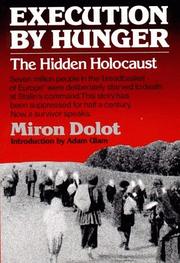
Execution by Hunger - The Hidden Holocaust by Miron Dolot is a survivor memoir, written decades later by a man who was a schoolboy in a Ukrainian village during the famine. Memoirs written long after events carry the usual reliability caveats, and it remains the most widely read first-person account in English. Holodomor Reader, edited by Bohdan Klid and Alexander Motyl, is the documentary collection — party directives, reports, testimony and press coverage assembled in one volume, and the place to go when you want to read the sources rather than a historian's use of them.
Everything Flows by Vasily Grossman is a novel, and its central section is a Ukrainian woman's account of the famine that many readers find the most affecting thing written about it. Grossman was a Soviet war correspondent whose work was suppressed; the book is fiction built from what he learned, and should be read as such.
The scholarship, and the argument inside it
Stalin's peasants by Sheila Fitzpatrick is the social history of collectivisation across the Soviet Union, and it explains the mechanism — requisition quotas, blacklisted villages, the passport system — with a precision the narrative accounts do not attempt.
The last four books are where the disagreement lives. The harvest of sorrow by Robert Conquest was the pioneering Western study and shaped the entire subject; it was written before the Soviet archives opened, its mortality figures have since been revised downward by archival research, and Conquest himself later modified his position on the question of premeditation. The years of hunger by R. W. Davies and Stephen Wheatcroft is the most detailed archival economic study, and it argues against a deliberate campaign of extermination, attributing the deaths to a brutal and ideologically driven policy that the leadership failed and then refused to correct. Stalin's genocides by Norman Naimark argues the opposite conclusion from overlapping evidence, holding that the events fit the concept of genocide as originally formulated. Bloodlands by Timothy Snyder places the famine alongside the other mass killings of the region between 1933 and 1945, a framing that has itself been criticised by historians who argue the comparison flattens distinct events.
Read Davies and Wheatcroft against Naimark rather than choosing one, and follow the full path in order for the sequence as designed.
Follow the full ordered path here: Best Books on the Holodomor, in Reading Order.