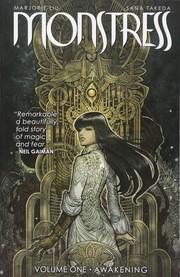
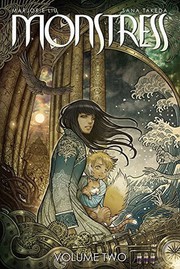
Start with Monstress, Vol. 1 and read straight through in numerical order. There are no side series, no prequels and no branching arcs: the collected volumes follow the single-issue run in sequence, and volume one collects the first six issues. If you were looking for a complicated answer, there is not one.
The real hazards with Monstress are not order. They are what the first volume assumes, and which physical edition you end up buying.
What you are reading
Marjorie Liu writes it and Sana Takeda draws it — the record here credits Liu alone, but the art is at least half the reason the series is famous, and any purchase decision should account for it. The setting is an alternate early-twentieth-century Asia, drawn in an art-nouveau register, after a catastrophic war between humans and the Arcanics. Maika Halfwolf is an Arcanic survivor missing an arm, carrying something ancient and hungry inside her, and looking for what happened to her mother.
It has won the Hugo Award for Best Graphic Story more than once and multiple Eisner Awards. It is also extremely violent — cannibalism, slavery, torture and the aftermath of a genocidal war are all on the page and central to the plot rather than decorative.
The volume order
Monstress, Vol. 1, Monstress, Vol. 2, Monstress, Vol. 3, Monstress, Vol. 4, Monstress, Vol. 5, Monstress, Vol. 6, Monstress, Vol. 7, Monstress, Vol. 8. That is the whole instruction.
Note that Monstress, Vol. 7 and Monstress, Vol. 8 are credited to Marjorie Liu without her middle initial in our records. Same writer, same series, inconsistent cataloguing.
The honest warning about volume 1
Monstress, Vol. 1 drops you into a fully built world with no exposition. Several factions with unfamiliar names — the Cumaea, the Federation, the courts, the Arcanic settlements — are all in play from the first pages, characters refer to a war you have not been told about, and the book expects you to keep reading and let it accrue rather than understand it immediately. A significant number of readers find the opening volume confusing and put it down.
The usual advice is give it three volumes. By the end of the third the political map has resolved and you will know whether the series is for you. If it has not taken by then, it will not.
The edition and language trap
Two practical problems, both of which cost money.
First, language: the catalogue records for Monstress, Vol. 1 and Monstress, Vol. 2 are a French edition and a Spanish edition respectively. Check the listed language before ordering, because a buy link built from those records may not land you on the English printing.
Second, editions: alongside the numbered paperbacks there are deluxe hardcovers that collect several volumes each. Mixing formats is how you end up with the same issues twice. Pick paperbacks or pick hardcovers and stay with the choice. There is also a side book, Talk-Stories, which is a short prose-and-art volume rather than part of the main run — it is optional and it is not in this list.
Where the catalogue stops
Our list runs to volume eight. The series continued past it, and later volumes are not in this catalogue, so do not treat volume eight as an ending — it is where our coverage ends, not where the story does. Check the publisher's current listing for what has appeared since.
Where to stop reading
There is no clean exit point built into the series; it is one continuous story rather than a set of arcs with resolutions. If you want a natural break, volume three is where the opening movement settles and the shape of the larger conflict becomes clear. Browse more comics reading orders on Discover, or see the Monstress hub for the full path.
Follow the full ordered path here: Monstress Reading Order: Where to Start and What Order to Read It In.