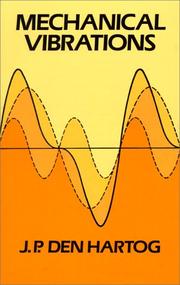
Vibration theory is applied differential equations with a linear-algebra core, and a sensible reading order follows the mathematics: one oscillator, then many, then a continuum. Start with Mechanical vibrations by J. P. Den Hartog — the 1934 text, 436 pages, still sold as a cheap Dover reprint — because it explains why machines shake in words and pictures before it reaches for an equation, and its treatment of isolation and self-excited oscillation is still standard. Read Vibration problems in engineering by Stephen Timoshenko second and selectively, for its systematic energy methods and its concrete worked problems.
Two things trip people up here, and neither is the physics. The first is prerequisites: everything past the classics assumes ordinary differential equations, matrix algebra and an undergraduate dynamics course, with Laplace transforms and Fourier analysis arriving from the second stage on. The second is that this list contains two pairs of books with identical display titles. Buy by author, every time.
The undergraduate course: four books, pick one
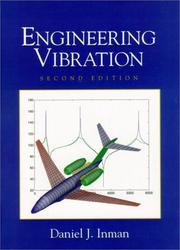
Engineering Vibration by Daniel J. Inman is the most widely adopted modern course text and the best balanced of the four — careful on the single-degree-of-freedom foundations, clear on the transition to matrix methods, strong on design and measurement. It is the default. Theory of Vibration with Applications by William T. Thomson is the compact, mathematically direct alternative: fewer words, more results, and a fuller treatment of the Lagrangian formulation and of random vibration.
Mechanical Vibrations by Singiresu S. Rao is the comprehensive one — the catalogue record runs to 1,104 pages — and it carries the numerical-methods and finite-element chapters the other two omit. It also carries exactly the same display title as Den Hartog's classic above, which is the single most likely mis-purchase on this path. Fundamentals of mechanical vibrations by S. Graham Kelly is the 1993 book at 643 pages, and it earns its place for the modelling step: how a real machine becomes a lumped-parameter system, which is the part students get wrong. Kelly wrote a later, differently titled textbook that is easy to confuse with it.
A note on editions before you order any of these. Several records here are dated to an early printing — Timoshenko's is filed under 1928 although the edition most engineers use is the much later revision prepared with Young and Weaver, and Inman and Rao have both been through further editions since the records shown. For coursework the edition matters, because problem sets are numbered against it.
Continuous systems and structural dynamics
Vibration of Continuous Systems is Rao again, on the distributed-parameter problem: wave equations, beam and plate vibration, and the approximate methods used when no closed form exists. It assumes the whole undergraduate course, so read it directly after.
From there the path crosses into the structural literature, which uses different notation for the same ideas. Fundamentals of structural dynamics is Craig and Kurdila, the bridge from vibration theory to finite-element analysis and the clearest source on component-mode synthesis. Dynamics of structures by Ray W. Clough is the civil-engineering classic, strongest on random vibration and earthquake response. Dynamics of structures by Anil K. Chopra shares that title exactly and is the modern earthquake-engineering standard — response spectra, inelastic response, seismic design. Read Chopra if your application is buildings, and skip it if it is machines; do not order either without checking the author.
Measurement, noise, and past the linear assumption
Modal testing by D. J. Ewins is the standard on experimental modal analysis and the necessary companion to all the theory above: how you actually measure a frequency response function and extract modal parameters from real hardware. The record here is dated 1984, while the second edition is the one in general use. Structural vibration by C. F. Beards is short and practical on damping — where it comes from and how to add it deliberately — which the big textbooks treat thinly.
Fundamentals of Noise and Vibration Analysis for Engineers by Michael Norton and Denis Karczub connects structural vibration to the sound it radiates, with the signal-analysis and statistical-energy methods used at high frequencies. It is the right book when the complaint is that something is loud rather than that something is shaking. Shock and vibration handbook is a reference to own rather than read, organised for lookup across isolation hardware, shock testing and machinery diagnostics; its record is dated 1961 and the handbook has been revised many times since. Close with Nonlinear Oscillations by Ali H. Nayfeh and Dean T. Mook, the standard reference on perturbation methods applied to vibrating systems, which needs everything above plus a tolerance for asymptotic analysis.
Work the stages in order, or start from the mechanical vibrations hub to see the related engineering subjects.
Follow the full ordered path here: The Best Books on Mechanical Vibrations, in Reading Order.