Start with Victor Fuchs's Who shall live?, the 1974 book by the economist who founded the field, which still states the central problem better than most of what followed: health care is a choice among competing goods under scarcity, and policy that pretends otherwise goes wrong in predictable ways. Then work through the formal apparatus in a textbook rather than picking it up piecemeal from journalism.
The reason for that order is that health care departs from the ordinary competitive model in specific, well-understood ways — moral hazard, adverse selection, third-party payment, supplier-induced demand, and an information asymmetry so severe that the seller frequently tells the buyer what to buy. Once you can name those mechanisms you can see them operating in any health system, and the vast popular literature on health care costs becomes much easier to evaluate. Note before you start that several of the books below are written by advocates for a position; where that is so, this guide says which position, because reading an argument as though it were a survey is the commonest mistake in this subject.
Why this market is different
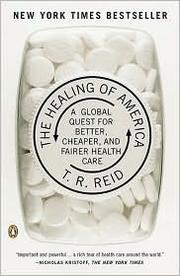
After Fuchs, Arnold Kling's Crisis of Abundance argues briefly and clearly that American spending growth is driven by premium medicine — more specialists, more imaging, more intervention — rather than by waste or profiteering. That is a position, and it is contested. T. R. Reid's The healing of America is reported journalism: he takes one damaged shoulder to doctors in five countries and reports what each system does with it, which is the most painless route into the four basic financing models.
The formal framework
Folland, Goodman and Stano's The economics of health and health care is the most widely assigned undergraduate text and the gentlest of the standard books, teaching the microeconomics as it goes rather than assuming it — insurance demand, the RAND experiment, physician agency, hospital behaviour. Bhattacharya, Hyde and Tu's Health Economics is the modern graduate treatment, unusually strong on the empirical literature and on comparative systems. Be careful buying it: Frank Sloan and Chee-Ruey Hsieh published a different MIT Press textbook under the identical title, which is the better choice if you want more pharmaceutical economics.
Where the money actually goes
Elisabeth Rosenthal's An American sickness works through the bill line by line — chargemasters, out-of-network billing, device markups — and is the clearest available account of how American prices are formed. It is reporting, not theory. Marty Makary's The Price We Pay covers predatory billing, middlemen and the unexplained variation in what the same procedure costs; Makary is a prominent advocate for price transparency and writes as one. Maggie Mahar's Money-Driven Medicine is the longer historical account of how American medicine became a market, and supplies the structural story behind both.
The policy arguments, set against each other
This stage is deliberately adversarial, and the underlying dispute is genuinely unresolved. David Goldhill's Catastrophic care argues that comprehensive insurance is itself the disease, because patients who never see a price cannot discipline a market; he is a businessman who came to the subject after his father died of a hospital infection, and it is the most persuasive statement of that view. John Goodman's Priceless is the full free-market prescription — health savings accounts, deregulated supply, price competition — and is openly an advocacy book. Ezekiel Emanuel's Which Country Has the World's Best Health Care? compares eleven systems on consistent criteria; Emanuel helped design the Affordable Care Act, and the book is more useful for being willing to name what the systems he prefers do badly. Read all three and you will have the honest shape of the disagreement rather than one side of it.
The working tools
Drummond and colleagues' Methods for the Economic Evaluation of Health Care Programmes is the standard reference for cost-effectiveness and cost-utility analysis — QALYs, discounting, sensitivity analysis — and the book you actually open if you ever have to appraise a technology. Paul Starr's The social transformation of American medicine is not economics at all but a Pulitzer-winning history of how the medical profession acquired cultural authority and then lost control to corporations and insurers; it explains why the market has the shape the models are trying to describe. This is a policy and analysis reading list, not guidance about your own care or coverage. For the adjacent field, see environmental economics.
Follow the full ordered path here: How to Learn Health Economics from Books, in Order.
Ready to learn something deeply?
Build a reading path — free