The first planet around a Sun-like star was confirmed in 1995. The count is now in the thousands, which means almost every popular book about exoplanets is a snapshot of a field that had already moved on by the time it was printed. Read them in publication order and you absorb three different eras of confidence about the same questions.
The other trap is the jump in difficulty. Two of the books below are graduate astrophysics with radiative transfer and orbital dynamics on nearly every page, and one is a professional reference nobody reads straight through. Knowing which is which before you buy is most of the value of a reading order.
Start with the overview that has aged best
Begin with The planet factory. Elizabeth Tasker is a working astrophysicist, and she organises the book around how planets form rather than around who discovered what, which is why it dates more slowly than the discovery narratives. It is popular science with no equations, and it does not condescend.
Follow it with Exoplanets by Michael Summers, a short tour of the genuinely strange worlds the surveys turned up: lava planets, water worlds, planets orbiting two stars at once. It is the lightest book here and works better second, because Tasker has already given you the physics to hang the weirdness on.
The discovery story, in period pieces
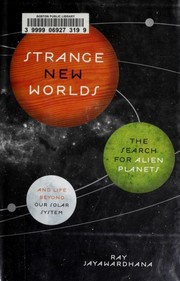
Four books tell the hunt itself, and they overlap. Strange new worlds by Ray Jayawardhana is the best balanced account of the early years. The crowded universe is Alan Boss writing from inside the committees and the radial-velocity race, while Mirror Earth covers much the same chase for an Earth twin from the outside; they duplicate each other heavily, so read one and skip the other. Five Billion Years of Solitude by Lee Billings is the literary one, more essay than reportage, and the only one of the four worth reading alongside the others rather than instead of them.
Treat all four as history. They were written before the full Kepler catalogue, before TESS, and before space telescopes began returning atmospheric spectra, so their sense of what is hard is out of date even where their science is not.
Where it stops being popular science
Exoplanets and Alien Solar Systems by Tahir Yaqoob is the bridge: real equations, worked unhurriedly, aimed at a reader comfortable with algebra and willing to meet a little calculus. Then Transiting Exoplanets by Carole Haswell is an actual university textbook. It assumes calculus, Newtonian mechanics and some basic radiation physics, and it is the right first technical book because the transit method produced most of the catalogue.
Exoplanet atmospheres by Sara Seager is a graduate text built on radiative transfer and thermodynamics; it is short, dense and unforgiving of gaps. The last two are references rather than reads. Exoplanets, the volume Seager edited, is a collection of specialist review chapters, and The Exoplanet Handbook by Michael Perryman is a comprehensive professional survey with thousands of citations, closer to an encyclopedia of the field than a book you work through. Neither belongs on a beginner's shelf, and both are indispensable later.
The habitability argument
Whether any of these worlds hold life is where the disagreement lives. Rare earth argues that microbial life may be common while complex life is vanishingly rare; it has been contested since publication, so read it as a strong position rather than a verdict. Astrobiology: A Very Short Introduction is the compact and careful counterweight, and Imagined Life by James Trefil is a speculative tour of what life built on unfamiliar chemistry might look like.
The path below keeps this sequence, so you meet the physics before the speculation and the textbooks only after you know why they matter. Browse more astronomy routes on our subject hubs if you want to go wider first.
Follow the full ordered path here: Best Books on Exoplanets, in Reading Order.