Design of experiments is two subjects wearing one name. There is the logic — randomisation, replication, blocking, confounding, what a factorial actually buys you — and there is the arithmetic, which is mostly linear models and ANOVA. Courses usually lead with the arithmetic, which is why so many people can run the analysis and cannot say why the design forced it.
So read the logic first, in a short book, before touching a 700-page course text. Then pick one practitioner reference and stay in it long enough to work problems. One warning about this list: two different books here display under the near-identical title Design and analysis of experiments — Douglas Montgomery's engineering course text and the graduate treatment by Angela Dean and Daniel Voss. They are not interchangeable, so buy by author.
The principles, before any formulas
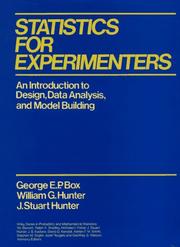
Statistics for experimenters is the natural entry point. Box, Hunter and Hunter teach factorials, fractional factorials and response surfaces through industrial examples, with an argument running underneath about experimentation as an iterative learning cycle rather than a single decisive test. It assumes basic statistics and no more.
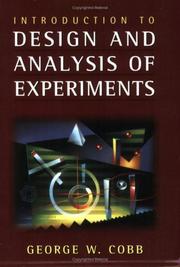
Planning of experiments is David Cox's short 1958 book on why designs are built the way they are — randomisation as the basis for inference, blocking against known nuisance variation, the cost of confounding. It is light on computation and remains one of the clearest statements of the reasoning. Introduction to design and analysis of experiments by George Cobb is the undergraduate companion to that idea: it is unusually careful about the structure of a design and how that structure determines the analysis you are entitled to run.
The practitioner core
Design and analysis of experiments by Montgomery is the standard engineering course text — broad, software-oriented, heavy on worked examples, and the book most industrial practitioners actually own. A First Course in Design and Analysis of Experiments by Gary Oehlert covers similar ground at a slightly higher level, with more attention to the underlying models; it has long been available free from the author, which makes it an easy second opinion.
Design and Analysis of Experiments with R by John Lawson is the implementation layer. Take it once you have chosen a design and need to fit it, rather than as a way to learn the design principles themselves.
Primary sources and theory
The design of experiments is Fisher's 1935 book, the source of the lady-tasting-tea thought experiment and of the argument that randomisation is what licenses the statistical inference. It is a primary source and reads like one; expect prose arguments rather than recipes, and expect positions later statisticians have qualified.
Design of Comparative Experiments by R. A. Bailey is the structural treatment — orthogonality, strata and the algebra of block structures — and it is genuinely demanding. Design and analysis of experiments by Dean and Voss is the graduate text proper: thorough, careful about assumptions, and the right reference when Montgomery has stopped answering your question. Experiments by C. F. Jeff Wu and Michael Hamada is the other graduate standard, strongest on industrial and robust-design problems.
Optimisation, quality engineering and applied fields
Response surface methodology by Raymond Myers and co-authors is the specialist book on optimising a process once you know which factors matter. Introduction to quality engineering is Genichi Taguchi's own statement of his approach. It is worth reading as a primary source, but the reception is genuinely split: Taguchi's emphasis on reducing variation and designing for robustness was widely accepted and influential, while statisticians including Box argued that the specific analysis methods — signal-to-noise ratios, the recommended designs — were inefficient and sometimes misleading. Read it knowing that argument exists.
Two applied books close the path. Trustworthy Online Controlled Experiments by Kohavi, Tang and Xu is the reference for A/B testing at scale, written from experience running experiments at large technology firms, and it is candid about how often organisations fool themselves. Field experiments by Alan Gerber and Donald Green does the same job for the social sciences, covering randomisation in the field, noncompliance and the design of experiments on real populations.
Work through it in that sequence and the arithmetic stops being arbitrary. You can follow the ordered path below, or start building your own list from the books you already own.
Follow the full ordered path here: How to Learn Design of Experiments from Books, in Order.