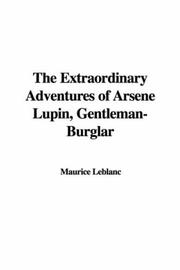
Start with The Extraordinary Adventures of Arsène Lupin, Gentleman-Burglar, the 1907 collection that introduced him. Nine stories, published in a magazine before they were a book, and the first of them opens with Lupin already arrested — which tells you what kind of series this is going to be.
Read in publication order. The tempting alternative is chronological: The Countess of Cagliostro (1924) shows Lupin at twenty, before any of the thefts, and several modern editions present it as book one on that basis. Read it late instead. Maurice Leblanc wrote it seventeen years in, for readers who already knew exactly who the man became, and almost all of its effect comes from that recognition.
The first run, 1907 to 1913
The Extraordinary Adventures of Arsène Lupin, Gentleman-Burglar establishes the figure: a gentleman thief who announces his crimes in advance, robs only people who can afford it, and treats the police as an audience. The best stories in it are the ones where he is in custody.
Arsène Lupin Versus Herlock Sholmes (1908) is the crossover. Leblanc set Lupin against Conan Doyle's detective, Doyle objected, and the name was scrambled — Herlock Sholmes here, Holmlock Shears in some English editions. Two long novellas, and the second is much the better.
The Hollow Needle (1909) is the first real novel and the one most readers name as the best. A schoolboy detective, Isidore Beautrelet, works out a secret that runs from the kings of France to Napoleon, and for once Lupin is genuinely outmatched. The book 813 (1910) is the most ambitious: Lupin is accused of murder, the plot reaches into imperial German politics, and it is the closest the series comes to a serious thriller. The Crystal Stopper (1912) is a political corruption story, tighter and nastier than its neighbours. The Confessions of Arsene Lupin (1913) returns to short stories.
The war and after, 1918 to 1924
The Golden Triangle (1918) is set in wartime Paris and shows the strain — Leblanc was writing propaganda-adjacent fiction and it reads that way in places. Secret of the Sarek, catalogued here under that form and usually published as The Secret of Sarek or Coffin Island, is the strangest book in the series: thirty coffins on a Breton island, a prophecy, and something much closer to horror than crime.
The Teeth of the Tiger (1921) has Lupin operating for most of its length under the identity of Don Luis Perenna, a device Leblanc leans on increasingly. The Eight Strokes of the Clock (1923) is eight linked stories with Lupin as Prince Renine, and it is the most purely enjoyable volume in the whole run — if a reader is going to bounce off the novels, hand them this instead.
Why this path stops in the mid-1920s
Leblanc kept writing Lupin until 1939 and the late books simply do not exist in English in any usable form. The Barnett Agency, The Mysterious Mansion, La Barre-y-va, The Woman with Two Smiles, Victor of the Vice Squad, The Countess of Cagliostro's Revenge and The Billions of Arsene Lupin were either never translated at all or exist only in scarce small-press editions. That is a fact about the English-language catalogue, not a judgement on the books; a reader with French has another fifteen years of Lupin available and an English reader effectively does not.
Two volumes to check before buying
The volume catalogued simply as Arsene Lupin is the novelisation of the stage play Leblanc wrote with Francis de Croisset, and The return of Arsène Lupin is a later reissue collection. Both overlap heavily with material in the books above. Check the contents page before buying either or you will pay twice for the same stories — a recurring hazard with a series this often repackaged.
A note on translations
Most Lupin in English is public domain and most cheap ebook editions reprint the same 1900s and 1910s translations. Several are abridged without saying so, the English has dated badly, and names and details are quietly altered. If a passage reads oddly, the translator is usually the reason rather than Leblanc. Newer translations exist and are worth seeking out for the novels in particular.
One last thing, since it is why many readers arrive here: the 2021 Netflix series is not an adaptation. Its protagonist is a reader of these books, which means nothing on screen spoils anything on the page.
More classic crime sits on the Arsene Lupin hub.
Follow the full ordered path here: Arsene Lupin Reading Order: Where to Start with Maurice Leblanc.